English
 Arabic
 French
 Spanish
 Portuguese
 Deutsch
 Turkish
 Dutch
Dutch
 Italiano
 Russian
 Romaian
 Portuguese (Brazil)
 Greek
Greek
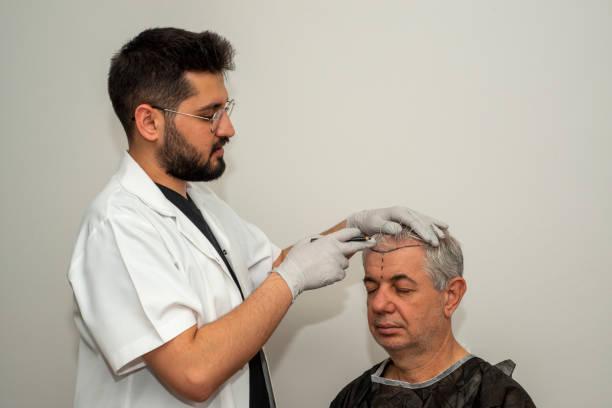
The most prominent indicator of aging for many men is the slow retreat of the temples and the softening of the frontal hairline. This "receding" look often changes the proportions of the face, making the forehead appear larger and limiting hairstyle choices. While some seek to "manage" the loss with styling products, those looking for a permanent solution often hesitate due to the perceived high cost of a "natural-looking" restoration. The fear is that a lower-cost option might result in a harsh, "straight-line" hairline that looks artificial and obvious.
A 1 Dirham Hair Transplant in Dubai is a clinical strategy designed to make high-density hairline restoration accessible. By utilizing a value-driven pricing model, patients can afford the 2,000 to 3,000 grafts often required to not only "fill the gaps" but to create a thick, soft, and feathered transition zone that mimics a youthful, non-receded state.
Why Is the "Transition Zone" Critical for a Quick Fix?
In clinical settings, we observe that the success of a hairline transplant isn't just about the number of hairs, but the type of hairs used at the very front. A "quick fix" must still follow the laws of facial architecture to look natural.
-
Micro-Irregularity: Natural hairlines are not straight; they have slight "macro and micro" zig-zags.
-
Single-Hair Follicles: The first 2–3 rows of a new hairline must consist exclusively of single-hair grafts to avoid a "pluggy" appearance.
-
Angulation: Hair at the temples grows at a much sharper downward angle than hair at the top.
-
Density Gradation: We transition from soft, fine hairs at the edge to thick, multi-hair units 1–2 centimeters back for structural volume.
Is This Hairline Strategy Safe for Younger Patients?
Who is the ideal candidate for a hairline fix?
The ideal candidate is someone whose hair loss has reached a "plateau." If a patient is still aggressively receding, we must design the transplant with "future-proofing" in mind, ensuring there is enough donor hair left to address any further recession that may occur behind the new hairline.
Based on post-procedure follow-ups, we prioritize safety by evaluating:
-
Miniaturization Mapping: We check if the hair behind the current recession is thinning. If so, those areas must be reinforced during the session.
-
Temple Point Stability: Restoring the "points" at the side of the head requires specific donor hair types (usually finer hair from behind the ears).
-
Family History: We use your genetic history to predict where your hairline might end up, ensuring the "1 Dirham" session is a long-term success, not just a temporary patch.
Actual Pain Levels: Rebuilding the Frame of the Face
Does it hurt more to have work done on the forehead?
The forehead and temples have more nerve endings than the back of the head, making the initial numbing phase slightly more noticeable. However, once the "nerve block" is active, the sensation is entirely neutralized.
-
Phase 1: The Frontal Block (5 Minutes): You will feel 4–6 stinging pinpricks along the brow line. Most patients rate this a 3/10 on the pain scale.
-
Phase 2: The Sensation of "Fullness": As the anesthetic fluid works, you may feel a sense of pressure or "tightness" in the forehead.
-
Phase 3: The Work Phase (6–8 Hours): You will feel a light tapping sensation. Because you are sitting in a reclined position, many patients find this a good time to catch up on podcasts or movies.
"I was obsessed with my hairline looking natural. The first few stings of the numbing were annoying, but after that, I didn't feel a thing. I could see the shape of my new hairline before I even left the clinic." — Steven
Realistic Recovery: Managing the "Visibility" Phase
Because the hairline is the most visible part of the face, managing the immediate post-op look is the primary concern for most patients.
When can I go out without a hat?
Most patients reach "social comfort" by Day 10. By this point, the initial swelling has subsided, and the scabs have shed, leaving a clean "stubble" look.
| Timeline | What the Patient Feels | What the World Sees |
| Day 1–3 | Tightness and mild forehead swelling. | A red "band" across the hairline. |
| Day 5 | Significant itching as the skin heals. | Tiny scabs forming around the grafts. |
| Day 10 | Relief as scabs wash away. | A very short, clean "buzz-cut" look. |
| Month 3 | The "Ugly Duckling" phase (shedding). | The area looks sparse again temporarily. |
| Month 6 | Excitement as new hair sprouts. | A visible, defined new hairline. |
What Feels Surprisingly Easy During Hairline Restoration?
-
The Post-Op Wash: Gently dabbing the hairline with foam is much easier and more soothing than patients anticipate.
-
The Transformation: Because the hairline frames the face, the visual change is immediate. Even with the scabs, patients often feel a "confidence boost" just seeing the new shape of their face.
-
The "One-Day" Process: For a receding hairline, 2,500 grafts can often be completed in 6–7 hours, making it a very efficient "one-day" transformation.
Common Questions: HAIRLINES & QUICK FIXES
Will people know I had a transplant?
If you follow the 14-day recovery protocol, the evidence of the surgery (redness and scabs) will be gone. After that, the hair enters a resting phase, and by the time it grows back, the transition is so gradual that most people simply think you’ve changed your styling or look "refreshed."
Can I choose my own hairline shape?
We work with you to design a shape that matches your facial proportions. However, we follow clinical "golden ratios" to ensure the hairline looks natural as you age. A "straight-line" hairline may look good at 25 but artificial at 50.
When can I cut my hair?
You can have a gentle haircut with scissors after 14 days for the non-transplanted areas. For the new hairline, we recommend waiting 4 weeks before using clippers or harsh styling products.
Is the 1 Dirham price really per graft?
Yes. At Tajmeels Clinic, our 1 Dirham model for hairline fixes is designed to be transparent. We calculate the exact number of grafts needed to give you the density you want, with no hidden surcharges for hairline design or "premium" placement.
Why Choose Tajmeels Clinic?
At Tajmeels Clinic, we understand that a hairline is more than just hair—it’s the frame of your face. Our 1 Dirham Hair Transplant in Dubai combines high-volume density with artistic precision. We specialize in "Micro-Grafting" techniques that ensure your new hairline is soft, natural, and undetectable. By choosing us, you are choosing a team that prioritizes long-term facial aesthetics and medical safety above all else.