English
 Arabic
 French
 Spanish
 Portuguese
 Deutsch
 Turkish
 Dutch
Dutch
 Italiano
 Russian
 Romaian
 Portuguese (Brazil)
 Greek
Greek
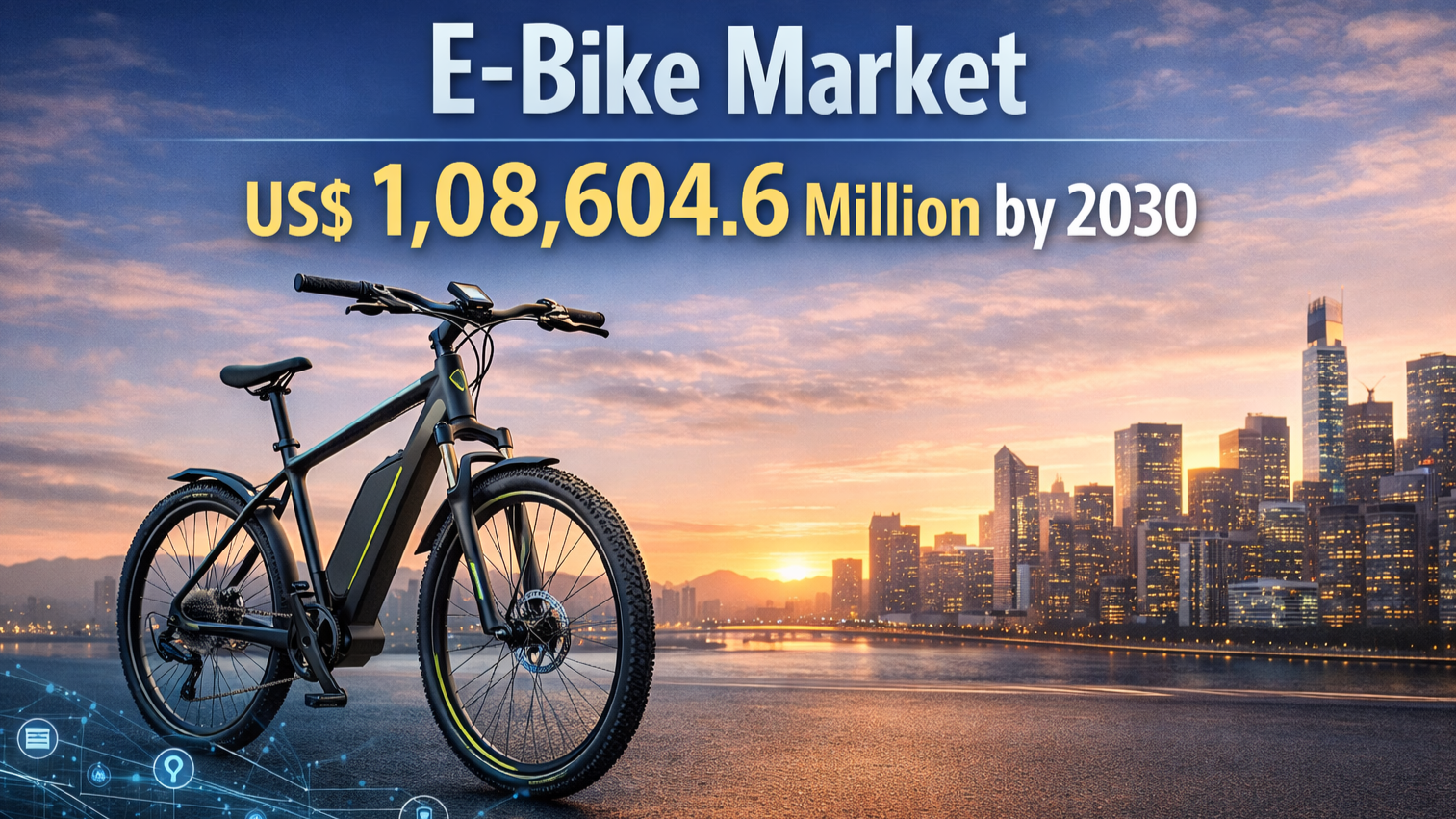
An electric bike, or e-bike, is a bicycle equipped with an integrated electric motor, rechargeable battery, and control system that assists the rider's pedaling to provide boosted propulsion, making it easier to tackle hills, longer distances, or headwinds without excessive effort.
E-Bike Market Analysis, Size, and Share
According to analysis by The Insight Partners, the global e-bike market was valued at US$ 39,660.1 million in 2022 and is projected to reach US$ 108,604.6 million by 2030, registering a CAGR of 13.4% during 2022–2030. The market is witnessing robust expansion, driven by rapid urbanization, supportive government policies, and growing consumer awareness of sustainable transportation. The steady rise reflects increasing demand for eco-friendly commuting solutions and advancements in battery and motor technologies.
Market Overview
The e-bike ecosystem consists of raw material suppliers, component manufacturers, OEMs, distributors, and end users. Raw materials such as aluminum, steel, plastic, rubber, and electronic components are fundamental to manufacturing. China remains a dominant hub in the global supply chain, contributing more than 50% of the production and supply of essential e-bike components, particularly batteries and motors. Other key manufacturing countries include Germany, Italy, Japan, and the United States.
The most critical components in an e-bike are the battery and motor system. Lithium-ion batteries have emerged as the leading battery type due to their lightweight design, higher energy density, and longer lifecycle. Meanwhile, mid-drive motors are increasingly preferred over hub motors because they offer improved torque distribution and better performance across varying terrains.
Major end users include urban commuters, recreational riders, and trekking enthusiasts. Growing fuel costs, traffic congestion, and environmental concerns have further accelerated consumer shift toward electric mobility. Additionally, the rise of e-bike sharing platforms and fleet-based mobility services is creating new revenue streams for manufacturers.
Download PDF Copy- https://www.theinsightpartners.com/sample/TIPAT00002409
Market Drivers
- Government Support for Low-Carbon Transportation
Governments across the globe are promoting e-bike adoption through subsidies, tax benefits, and incentive schemes aimed at reducing carbon emissions. For instance, India and several European countries have introduced subsidy programs encouraging consumers to adopt electric two-wheelers. Such initiatives are significantly boosting market penetration.
- Technological Advancements and Smart Integration
Manufacturers are increasingly integrating lightweight materials, IoT-enabled features, GPS tracking, anti-theft systems, and app-based connectivity into e-bikes. Companies such as Robert Bosch GmbH continue to innovate motor systems, including compact and high-performance drive units designed for lightweight urban e-bikes.
- Expansion of Manufacturing Capacity
Investments in production infrastructure are also supporting market growth. E-bike manufacturers are scaling operations to meet rising global demand, particularly in Asia-Pacific and Europe.
Segmentation Insights
- By Battery Type: Lithium-ion dominates the market, followed by lithium-ion polymer, lead-acid, and nickel-metal hydride.
- By Motor Type: The market is segmented into hub motors and mid motors, with mid motors holding a larger share in 2022.
- By Class: Class I e-bikes (pedal-assist only) accounted for the largest share, driven by favorable regulations and safety standards.
- By Mode: Pedal-assist mode remains the preferred option, particularly in Europe and North America.
Regional Analysis
The market spans North America, Europe, Asia Pacific, Middle East & Africa, and South & Central America. In 2022, Asia Pacific led the global market, supported by strong manufacturing capabilities and high domestic demand in China and Japan. Europe ranked second, benefiting from stringent emission regulations and cycling-friendly infrastructure. North America is also witnessing growing adoption, particularly in urban centers where micro-mobility solutions are gaining traction.
Key Players in the E-Bike Market
Leading companies are focusing on product innovation, partnerships, and geographic expansion to strengthen their competitive positioning. Major players include:
- Haibike
- Aventon Bikes
- Giant Manufacturing Co Ltd
- Merida Industry Co., Ltd.
- Pedego Electric Bikes
- Robert Bosch GmbH
- Specialized Bicycle Components, Inc.
- Shimano Inc.
- Trek Bicycle Corp.
- Yamaha Motor Co Ltd
These companies are investing heavily in R&D to enhance battery efficiency, motor power, lightweight frame design, and smart connectivity features.
Future Outlook
The future of the e-bike market appears highly promising, supported by favorable regulatory frameworks, technological innovation, and changing consumer mobility patterns. The integration of AI-enabled diagnostics, improved battery chemistry, and connected mobility ecosystems will likely redefine user experience. Expansion of charging infrastructure and battery-swapping solutions may further reduce range anxiety. Additionally, the growth of last-mile delivery services and corporate fleet electrification will open new opportunities for commercial e-bike adoption. With sustainability becoming central to global transportation strategies, the e-bike industry is expected to play a vital role in shaping the next generation of urban mobility solutions through 2030 and beyond.
Other Reports-