 English
 Arabic
 French
 Spanish
 Portuguese
 Deutsch
 Turkish
 Dutch
Dutch
 Italiano
 Russian
 Romaian
 Portuguese (Brazil)
 Greek
Greek
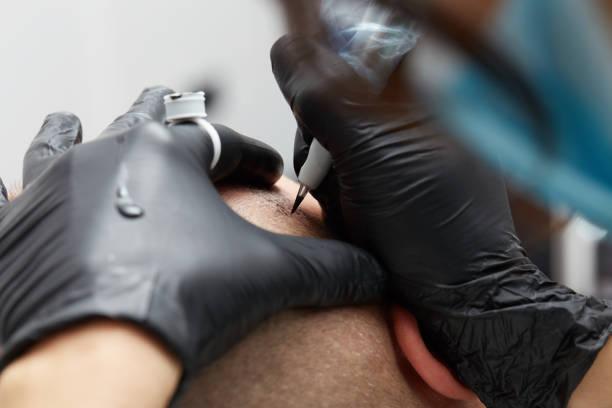
The psychological impact of a receding hairline or thinning crown often leads to a frantic search for solutions that are either invasive or temporary. While hair transplants are a gold standard for many, not every patient has the donor hair or the desire for surgery. Scalp Micropigmentation in Dubai has emerged as a high-precision, non-surgical alternative that effectively "camouflages" hair loss and surgical scarring by depositing specialized pigments into the upper dermal layer. This procedure does not just mask baldness; it meticulously replicates the appearance of natural hair follicles, providing an immediate visual restoration of density and a seamless concealment of previous surgical marks. However, achieving a realistic result, especially over scar tissue, requires an understanding of scalp anatomy and pigment stability.
Can SMP Effectively Hide Hair Transplant Scars?
How does pigment behave on surgical scar tissue?
Yes, Scalp Micropigmentation is one of the most effective methods for concealing both FUE (Follicular Unit Extraction) "white dots" and FUT (Follicular Unit Transplantation) linear scars. However, scar tissue is physiologically different from healthy skin; it is often denser, less vascularized, and can be either raised (hypertrophic) or recessed (atrophic). In clinical settings, we observe that scar tissue holds pigment differently—sometimes requiring more sessions to build up the necessary "shading" to match the surrounding hair. The goal is to break up the flat, reflective surface of the scar by adding follicle-like impressions that mimic the texture of the natural donor area.
What Does Scar Concealment Feel Like?
Are pain levels higher when treating scar tissue?
Treating a scar with SMP can be slightly more sensitive than treating healthy skin, though it remains well within the tolerable range. Patients often describe the sensation as a localized "vibration" or a sharp "pinging" feeling. Because scar tissue lacks the standard nerve distribution of healthy skin, you might feel very little in the center of the scar but experience increased sensitivity at the edges where the scar meets healthy tissue. On a pain scale of 1 to 10, clinical feedback for scar work typically ranges between a 3 and 5.
"I had a prominent linear scar from a strip surgery ten years ago that always made me self-conscious at the gym. The SMP session on the scar felt a bit more intense than the rest of my scalp, but the relief of finally seeing that white line disappear was worth every second."
— Stefan
The Realistic Recovery Timeline for Scar Work
How does the healing process differ for concealed scars?
While the general recovery for SMP is fast, scar tissue may require a slightly more cautious approach during the first week.
-
Days 1–3: The scar area may look slightly raised or more inflamed than healthy skin. Pigment will appear very dark.
-
Days 4–7: You may notice more "shedding" over the scar area. It is vital not to pick at any flaking skin, as scar tissue is more prone to pigment rejection if the surface is disturbed.
-
Days 8–14: The "ghosting" phase where the pigment seems to fade. This is common as the tough scar tissue absorbs the ink.
-
Day 30: The final tone is revealed. Most scars require a second or third "pass" to ensure the color matches the surrounding natural hair perfectly.
Who Should Avoid SMP for Scar Concealment?
Are there specific reasons to delay scar treatment?
-
New Scars: A scar must be fully matured before SMP can be applied. In clinical settings, we recommend waiting at least 6 to 12 months post-surgery until the scar has turned from pink/red to white.
-
Keloid History: If your body produces raised keloid scars, the micro-needling process could potentially worsen the texture of the existing scar.
-
Unstable Scars: Scars that are still painful, itchy, or changing shape are not ready for pigmentation.
-
Infection: Any signs of folliculitis or active infection in the donor area must be cleared before treatment.
Comparing SMP for Scarring vs. General Density
| Feature | SMP for General Density | SMP for Scar Concealment |
| Technique | Standard dot distribution | Layered "stippling" and shading |
| Needle Depth | Consistent (0.5mm - 1.5mm) | Variable (Adjusted for tissue density) |
| Number of Sessions | 2 to 3 sessions | 3 to 4 sessions (for better blending) |
| Pigment Retention | Very high | Moderate (Requires layering) |
| Immediate Result | Uniform shading | Pattern interruption of the scar |
Technology and Technique Specifics for Scars
How do practitioners adjust settings for tough tissue?
Practitioners must adjust the intensity and needle stroke when working on scar tissue. Because the tissue is fibrous, a higher "hit rate" or motor speed is often used to ensure the needle doesn't "bounce" off the scar. Based on post-procedure follow-ups, we find that using a slightly smaller needle diameter for scars helps create a more refined "stubble" look that prevents the dots from merging into a solid dark line, which would only draw more attention to the scar.
"I had those 'moth-eaten' white dots from a bad FUE job elsewhere. After two sessions of SMP at the clinic, the back of my head looks totally uniform. I can finally get a skin fade without worrying about the spots showing."
— Vikram
Scar Concealment Questions Answered
Can SMP hide scars from accidents or burns?
Yes, as long as the tissue is healthy and fully healed. SMP is highly effective at camouflaging various types of trauma-induced scarring on the scalp by mimicking the surrounding hair follicles.
Will the pigment turn blue on the scar?
No. At a professional clinic, we use specialized carbon-based pigments that do not contain the blue/green additives found in traditional tattoo inks. The pigment will fade into lighter shades of grey/black over time.
How long does scar concealment last?
Typically, SMP on scar tissue lasts between 3 and 5 years before a refresh is needed. Scar tissue may occasionally require a touch-up sooner than healthy skin due to the way it holds ink.
Can I have SMP if I’m planning another hair transplant?
Yes, but you must wait until the new transplant has fully healed. Conversely, if you get SMP first, the pigment will not interfere with any future hair transplant surgeries.
Why Choose Tajmeels Clinic
Concealing a scar requires a higher level of technical expertise than standard density work. At Tajmeels Clinic, we understand the unique challenges of working with fibrous tissue. We don't just "cover" the scar; we use advanced Scalp Micropigmentation in Dubai to artistically blend the area into your natural hair pattern. Our clinicians are trained to read the texture and "pull" of the skin, ensuring that the pigment remains crisp and the concealment is undetectable under any lighting. By choosing our clinical environment, you are opting for medical-grade precision and a tailored approach that prioritizes the long-term integrity of your scalp. Choose Tajmeels Clinic to turn your surgical history into a private secret.
