English
 Arabic
 French
 Spanish
 Portuguese
 Deutsch
 Turkish
 Dutch
Dutch
 Italiano
 Russian
 Romaian
 Portuguese (Brazil)
 Greek
Greek
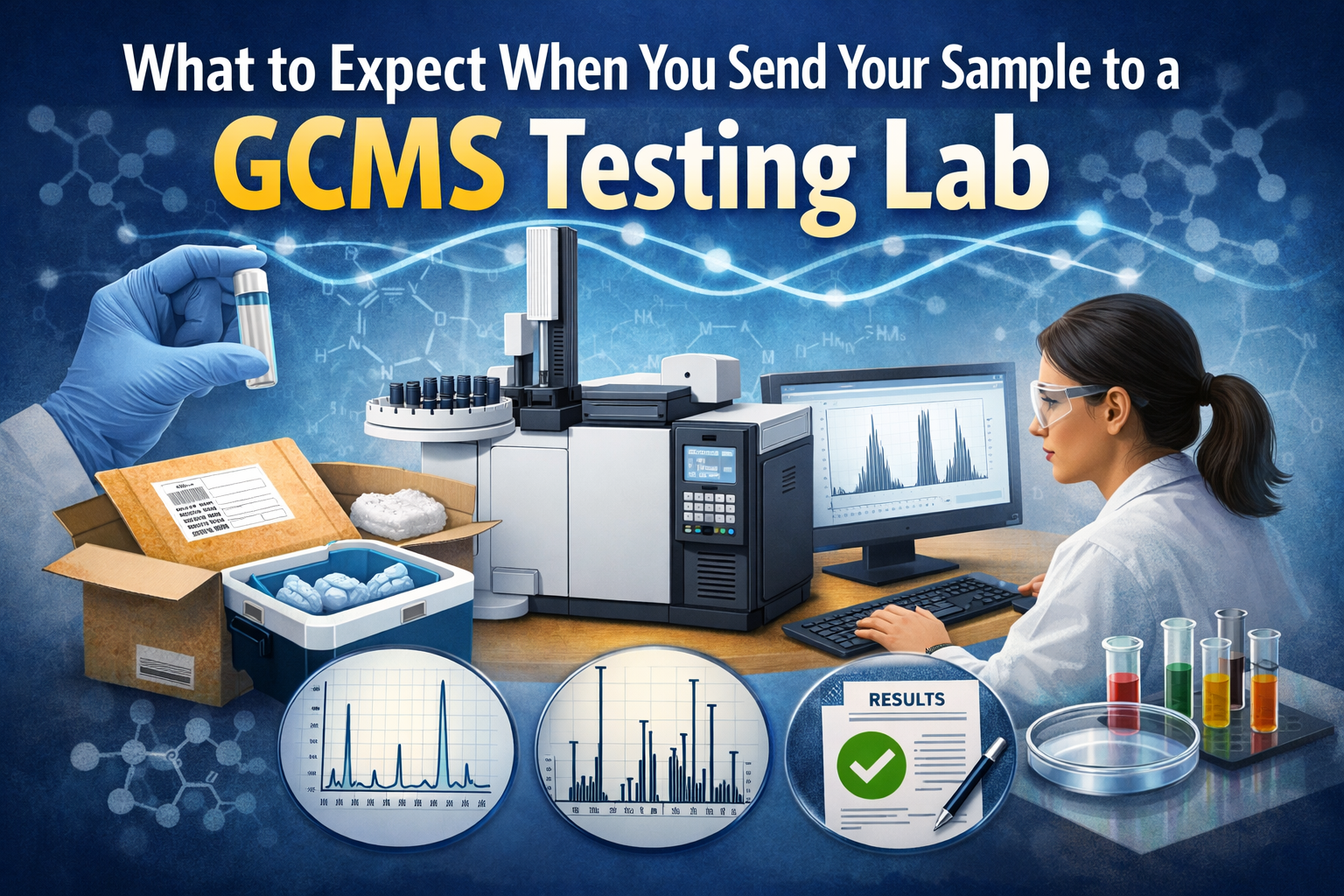
Sending a sample to a GCMS testing lab can feel like handing off something important without fully knowing what happens next. Whether you’re testing for contaminants, verifying product purity, conducting research, or meeting regulatory requirements, understanding the full laboratory process helps you prepare properly—and avoid costly delays.
Understanding GCMS: Why It’s So Widely Used
Gas Chromatography–Mass Spectrometry (GCMS) is considered one of the gold standards in analytical chemistry.
It combines two powerful techniques:
-
Gas Chromatography (GC) – Separates individual compounds within a complex mixture.
-
Mass Spectrometry (MS) – Identifies and quantifies those compounds based on their molecular mass and fragmentation pattern.
Because of its sensitivity, selectivity, and reliability, GCMS is used in:
-
Pharmaceutical testing
-
Environmental monitoring
-
Food safety analysis
-
Forensic investigations
-
Cannabis compliance testing
-
Petrochemical and industrial analysis
It can detect compounds at trace levels (ppm, ppb, or even lower), making it ideal for regulatory and quality control applications.
Step-by-Step: What Happens After You Send Your Sample
1. Pre-Submission Planning (Before You Ship)
The process actually begins before your sample leaves your facility.
A reputable lab will typically ask:
-
What compounds are you testing for?
-
What is the sample matrix (water, soil, oil, plant material, biological fluid)?
-
What concentration range do you expect?
-
Are there regulatory standards involved?
-
Do you need qualitative identification, quantitative results, or both?
This discussion determines:
-
The analytical method used
-
Required sample volume
-
Preservation requirements
-
Detection limits
-
Turnaround time
Failing to clarify expectations at this stage is one of the most common causes of delays or unusable data.
2. Sample Submission and Chain of Custody
Once shipped, your sample arrives at the laboratory’s receiving department.
Chain of Custody (CoC)
The chain of custody is a formal document that tracks:
-
Who collected the sample
-
When it was collected
-
Storage conditions
-
Transfer history
-
Requested analyses
This documentation is especially critical for:
-
Environmental compliance
-
Legal cases
-
Regulatory audits
Every transfer is documented to maintain sample integrity and defensibility.
3. Sample Receipt and Accessioning
Upon arrival:
-
The sample is inspected for damage or leakage.
-
Temperature (if required) is recorded.
-
Labels are verified against paperwork.
-
The sample is logged into the laboratory information management system (LIMS).
-
A unique laboratory ID is assigned.
At this point, the lab officially takes custody of your sample.
If there are discrepancies—such as broken containers, incorrect labeling, or insufficient volume—the lab will contact you immediately before proceeding.
4. Sample Storage and Preservation
Not all samples are analyzed immediately.
Depending on the matrix, the lab may:
-
Refrigerate at 2–8°C
-
Freeze at –20°C or lower
-
Store in dark conditions to prevent degradation
-
Maintain in airtight containers
Certain compounds are volatile or degrade quickly. Holding times are strictly monitored to ensure accurate results.
If holding times are exceeded, results may be flagged in the final report.
5. Sample Preparation (The Most Critical Stage)
Sample preparation is often more complex than the GCMS run itself.
Because GCMS requires volatile and thermally stable compounds, many samples must be processed first.
Common Preparation Techniques:
• Liquid-Liquid Extraction (LLE): Separates analytes from aqueous matrices into organic solvents.
• Solid-Phase Extraction (SPE): Concentrates analytes and removes interferences.
• Headspace Analysis: Used for volatile organic compounds (VOCs).
• Derivatization: Chemically modifies compounds to:
-
Improve volatility
-
Increase stability
-
Enhance detection sensitivity
Improper preparation can result in:
-
Poor recovery
-
Matrix interference
-
False negatives
-
Suppressed signals
Experienced analysts carefully validate each step to minimize errors.
6. Instrument Calibration and Quality Control
Before your sample is run, the instrument must be calibrated.
Calibration Process
The lab prepares:
-
Multiple calibration standards at known concentrations
-
Internal standards
-
Blank samples
A calibration curve is generated by plotting instrument response versus concentration.
For the run to be valid:
-
Correlation coefficients must meet acceptance criteria
-
QC standards must fall within tolerance limits
If the calibration fails, the system must be recalibrated before any samples are analyzed.
7. The GCMS Analysis Itself
Now the prepared sample is introduced into the GCMS system.
Inside the Gas Chromatograph
-
The sample is injected into a heated inlet.
-
It vaporizes instantly.
-
An inert carrier gas (often helium) pushes the vapor through a capillary column.
-
Compounds separate based on:
-
Boiling point
-
Polarity
-
Interaction with column coating
-
Each compound exits the column at a specific retention time.
Inside the Mass Spectrometer
-
Compounds are ionized (commonly via electron ionization).
-
Molecules fragment into predictable patterns.
-
The instrument measures mass-to-charge ratios (m/z).
-
A mass spectrum is generated.
The spectrum is compared against reference libraries to confirm identity.
8. Data Processing and Interpretation
The raw output is not the final result.
Analysts must:
-
Integrate peaks correctly
-
Confirm retention times
-
Verify mass spectral matches
-
Review internal standard performance
-
Check signal-to-noise ratios
For quantitative testing, the concentration is calculated using:
-
Calibration curve equations
-
Response factors
-
Dilution corrections
If anomalies appear—such as unexpected peaks or poor recovery—the sample may be re-prepared or re-run.
9. Quality Assurance Review
Before release, the data undergoes independent review:
-
QC sample verification
-
Blank contamination check
-
Spike recovery assessment
-
Method compliance confirmation
-
Regulatory threshold comparison
This step ensures the data is legally defensible and scientifically sound.
In regulated industries (e.g., pharmaceuticals), this review process is especially rigorous.
10. Final Report Generation
Once approved, the lab generates your final report.
A comprehensive GCMS report typically includes:
-
Sample identification
-
Method reference
-
Date of analysis
-
Identified compounds
-
Concentration values
-
Units of measurement
-
Detection limits
-
Quality control summary
-
Authorized signatures
Some labs also include chromatograms and mass spectra as attachments.
Typical Turnaround Times
Turnaround depends on:
-
Sample complexity
-
Number of analytes
-
Lab workload
-
Required sensitivity
-
Whether method development is needed
General estimates:
-
Routine analysis: 3–10 business days
-
Complex matrices: 7–14 business days
-
Expedited services: 24–72 hours (if available)
Rush requests often incur additional fees.
Common Reasons for Delays
Understanding these can save time and money:
-
Incomplete paperwork
-
Improper containers
-
Insufficient sample volume
-
Unexpected matrix interference
-
Instrument downtime
-
QC failure requiring reanalysis
Clear communication with the lab minimizes these risks.
How to Ensure a Smooth Testing Experience
To get the most reliable results:
-
Confirm required sample volume in advance.
-
Follow preservation guidelines carefully.
-
Clearly state your analytical objectives.
-
Disclose known contaminants or hazards.
-
Ask about detection limits before testing begins.
-
Ship samples using appropriate packaging.
Proactive planning significantly improves turnaround and data quality.
Final Thoughts
Sending a sample to a GCMS testing lab is not a simple “plug and test” process. It is a carefully controlled, multi-step scientific workflow designed to deliver precise, defensible, and reproducible results.
From accessioning and storage to preparation, calibration, analysis, validation, and reporting - every stage matters.
When you understand what happens behind the scenes, you can:
-
Avoid delays
-
Improve compliance
-
Reduce costs
-
Strengthen quality assurance
-
Make better data-driven decisions
The more prepared you are before submission, the smoother—and more valuable—the entire GCMS testing experience will be.