English
 Arabic
 French
 Spanish
 Portuguese
 Deutsch
 Turkish
 Dutch
Dutch
 Italiano
 Russian
 Romaian
 Portuguese (Brazil)
 Greek
Greek
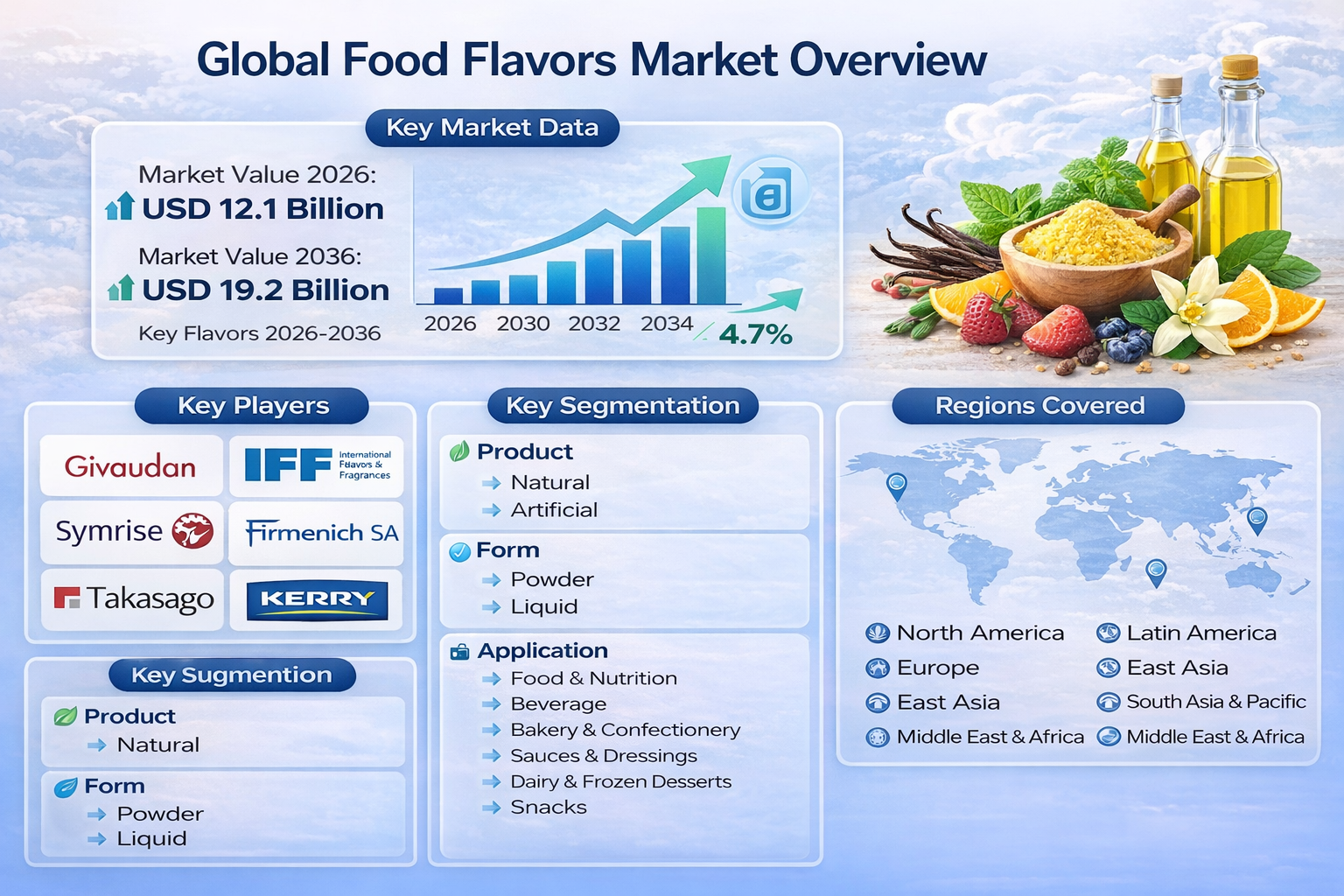
Food Flavors Market Outlook
The global Food Flavors market is entering a decisive decade of transformation, driven by evolving consumer expectations around taste authenticity, ingredient transparency, and regulatory flexibility. Valued at USD 12.1 billion in 2026, the market is projected to reach USD 19.2 billion by 2036, expanding at a compound annual growth rate (CAGR) of 4.7%, according to analysis by Future Market Insights (FMI).
Growth momentum is increasingly anchored in the rising demand for natural and clean-label flavor solutions, as food manufacturers recalibrate formulations to align with health-conscious consumption patterns. Consumers are no longer satisfied with artificial taste enhancers; instead, they are demanding deeper, more authentic sensory experiences derived from responsibly sourced ingredients.
This shift was reinforced in July 2025, when the U.S. Food and Drug Administration (FDA) announced the elimination of 52 standards of identity across various food categories, including flavorings. The regulatory update removed legacy constraints that had historically limited formulation flexibility, enabling manufacturers to accelerate innovation. However, industry stakeholders caution that regulatory freedom must be matched with strategic diligence to mitigate formulation, sourcing, and compliance risks over the long term.
“Consumers want the ultimate taste experience. They want it to be ‘more tomatoey’ or ‘more chickeny.’ They want real food made with the best natural ingredients that have been carefully sourced and prepared,” said Emmanuel Laroche, Vice President Marketing & Consumer Insights and Global Marketing Leader at Symrise.
Stay Ahead with Data-Backed Decisions. Gain Preview Access to Methodology, Sample Charts, and Key Findings by: Requesting Your Sample Report!
Natural Ingredients and Supply Chain Efficiency Drive Adoption
Manufacturers across the food ecosystem are rapidly expanding portfolios centered on natural fruit, vegetable, and botanical-based flavors. Supporting this trend, a 2025 USDA report highlighted that global orange production is expected to rise by 1% to 47.4 million metric tons, improving raw material availability for citrus-based flavor applications. These efficiency gains are strengthening investor confidence, particularly among institutional players focused on yield stability and scalable supply chains.
At the same time, capital allocation is increasingly flowing into encapsulation technologies that improve shelf life, stability, and controlled flavor release—capabilities critical for global food distribution.
Quick Stats: Food Flavors Market Snapshot
- Market Value (2026): USD 12.1 Billion
- Market Value (2036): USD 19.2 Billion
- Forecast CAGR (2026–2036): 4.7%
- Leading Component: Powder (65%)
- Leading End User: Food & Nutrition (62%)
- Leading Application: Beverages
- Key Growth Regions: USA, UK, Germany, Japan, South Korea
Powder Formats Dominate Due to Stability and Scalability
Powdered flavors are expected to command 65% of the market, supported by their superior stability, extended shelf life, and cost-efficient transportation. Unlike liquid formats, powders integrate seamlessly into bakery, confectionery, beverage, and nutrition applications, enabling manufacturers to maintain consistent flavor dispersion at scale.
The adoption of encapsulated powder flavors further strengthens this dominance by protecting sensitive compounds and ensuring controlled release during processing and consumption.
Food & Nutrition Emerges as the Leading Application Segment
The Food & Nutrition segment is projected to account for 62% of total demand, driven by the global expansion of processed foods, fortified nutrition products, and plant-based alternatives. Flavor systems are increasingly used to mask off-notes associated with functional ingredients such as proteins, vitamins, and minerals.
Data released by Kerry Group in February 2025 showed that its Taste & Nutrition division achieved 3.4% volume growth in 2024, underscoring strong demand across foodservice and health-oriented product lines.
Regional Growth Patterns Reflect Regulatory and Cultural Nuances
Market expansion remains uneven across regions. North America leads in clean-label reformulation and regulatory alignment, while East Asia emphasizes savory profiles and convenience foods. Emerging markets are adopting robust flavor systems to enhance staple foods, whereas mature economies prioritize transparency and sustainability.
Country-level CAGR projections (2026–2036) include:
- USA: 4.6%
- UK: 4.3%
- Germany: 4.5%
- Japan: 4.4%
- South Korea: 4.7%
Germany, in particular, stands out for its strong organic preference. A 2024 BMEL survey found that 76% of German consumers cite health as the primary driver for purchasing organic products, accelerating demand for certified natural flavors.
Competitive Landscape Shifts Toward “Taste-and-Nutrition” Ecosystems
The competitive environment is consolidating as major players evolve from standalone flavor suppliers into integrated taste-and-nutrition solution providers. FMI analysis indicates increased M&A activity, with leading firms acquiring niche natural ingredient companies to strengthen clean-label portfolios and supply chain resilience.
Key players shaping the market include Givaudan, International Flavors & Fragrances (IFF), Symrise AG, Firmenich SA, Takasago, Kerry Group, and Sensient Technologies.
“We are capturing growth and enhancing margin quality through focused execution of our ONE Symrise strategy,” said Jean-Yves Parisot, CEO of Symrise AG, reflecting a broader industry pivot toward high-margin, value-added solutions.
Outlook
As consumer scrutiny intensifies and regulatory frameworks evolve, the Food Flavors market is transitioning from volume-driven growth to precision-led innovation. Companies that balance clean-label transparency, sourcing integrity, and scalable formulation technologies are expected to define the next phase of global flavor leadership.
Why Choose FMI: Empowering Decisions that Drive Real-World Outcomes: https://www.futuremarketinsights.com/why-fmi
𝐃𝐢𝐬𝐜𝐨𝐯𝐞𝐫 𝐦𝐨𝐫𝐞 𝐢𝐧-𝐝𝐞𝐩𝐭𝐡 𝐫𝐞𝐬𝐞𝐚𝐫𝐜𝐡 𝐫𝐞𝐩𝐨𝐫𝐭𝐬 𝐚𝐧𝐝 𝐬𝐭𝐫𝐚𝐭𝐞𝐠𝐢𝐜 𝐢𝐧𝐬𝐢𝐠𝐡𝐭𝐬 𝐨𝐧 𝐭𝐡𝐞 𝐅𝐨𝐨𝐝 & 𝐁𝐞𝐯𝐞𝐫𝐚𝐠𝐞 𝐢𝐧𝐝𝐮𝐬𝐭𝐫𝐲 𝐟𝐫𝐨𝐦 𝐅𝐮𝐭𝐮𝐫𝐞 𝐌𝐚𝐫𝐤𝐞𝐭 𝐈𝐧𝐬𝐢𝐠𝐡𝐭𝐬 (𝐅𝐌𝐈).
Thioglycolate Market : https://www.futuremarketinsights.com/reports/thioglycolates-market
Stabilized Starch Market : https://www.futuremarketinsights.com/reports/stabilized-starch-market
Food Minerals Market : https://www.futuremarketinsights.com/reports/food-minerals-market
About Future Market Insights (FMI)
Future Market Insights, Inc. (ESOMAR certified, recipient of the Stevie Award, and a member of the Greater New York Chamber of Commerce) offers profound insights into the driving factors that are boosting demand in the market. FMI stands as the leading global provider of market intelligence, advisory services, consulting, and events for the Packaging, Food and Beverage, Consumer Technology, Healthcare, Industrial, and Chemicals markets. With a vast team of over 400 analysts worldwide, FMI provides global, regional, and local expertise on diverse domains and industry trends across more than 110 countries.
Contact Us:
Future Market Insights Inc.
Christiana Corporate, 200 Continental Drive,
Suite 401, Newark, Delaware – 19713, USA
T: +1-347-918-3531
For Sales Enquiries: sales@futuremarketinsights.com
Website: https://www.futuremarketinsights.com
LinkedIn| Twitter| Blogs | YouTube