 English
 Arabic
 French
 Spanish
 Portuguese
 Deutsch
 Turkish
 Dutch
Dutch
 Italiano
 Russian
 Romaian
 Portuguese (Brazil)
 Greek
Greek
Global Gin Market Outlook
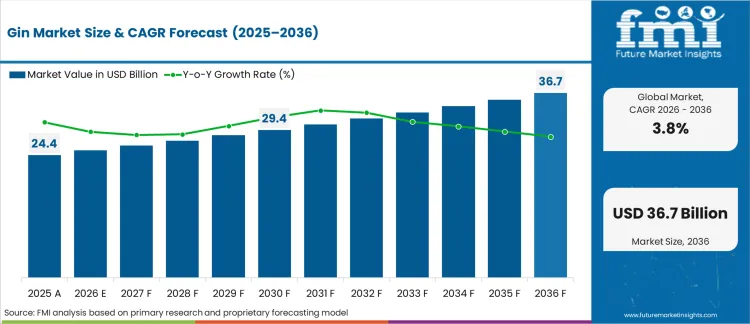
The global gin market continues to demonstrate resilient expansion, supported by premiumization strategies, rising cocktail experimentation, and growing cross-border accessibility. According to the latest analysis by Future Market Insights (FMI), the global gin industry was valued at USD 24.4 billion in 2025 and is projected to reach USD 25.3 billion in 2026. Over the forecast period from 2026 to 2036, revenues are expected to climb to USD 36.5 billion, reflecting a steady 3.8% CAGR.
FMI analysts indicate that structural growth is no longer driven purely by heritage positioning. Instead, experiential consumption, botanical storytelling, and evolving retail dynamics are reshaping procurement strategies worldwide.
Market Overview and Definition
Gin is defined as a distilled spirit deriving its predominant flavor profile from juniper berries, serving both retail and hospitality sectors. Commercial formulations incorporate complex botanical blends while adhering to regulated alcohol-by-volume (ABV) thresholds and strict distillation protocols.
The report evaluates London Dry, Plymouth, Old Tom, and modern botanical formats across on-trade and off-trade channels, covering over 40 countries. Revenue calculations incorporate wholesale transactions, import-export flows, and production benchmarks validated through corporate disclosures and official trade statistics.
Key Market Metrics of Gin Market
- Industry Size (2026): USD 25.3 Billion
- Projected Value (2036): USD 36.5 Billion
- Forecast CAGR: 3.8%
- Leading Product Type: London Dry Gin (35% share in 2026)
- Dominant Sales Channel: Off-trade (58% share in 2026)
Premiumization Redefines Growth Trajectory
Mature markets in North America and Europe exhibit value-led stabilization, with suppliers increasingly extracting margin from super-premium expressions. Data from the Distilled Spirits Council confirms that U.S. super-premium gin volumes grew 187% between 2019 and 2024, demonstrating strong consumer willingness to trade up.
Simultaneously, multinational producers are reinforcing portfolio resilience through zero-proof variants. Pernod Ricard expanded its reach with Beefeater 0.0%, targeting sober-curious consumers seeking classic botanical profiles without alcohol.
Distribution consolidation is also accelerating. In February 2025, Pernod Ricard wholly acquired Inverroche to strengthen its premium African footprint. Similarly, Diageo India announced a majority stake acquisition in NAO Spirits in June 2025 at an enterprise value of ₹130 crore, signaling aggressive localization in high-growth markets.
Regional Growth Highlights
- North America
North America reflects mature but high-value consumption dynamics. The United States is projected to grow at 5.4% CAGR through 2036, driven by domestic craft innovation and export momentum. U.S. gin exports rose 34% to USD 38 million in 2024, underscoring rising global demand for American botanical expressions.
- Europe
Europe maintains structural dominance as both leading exporter and core consumer base. The United Kingdom is forecast to expand at 5.8% CAGR, supported by exports that reached USD 672.4 million in 2024. Germany follows closely with a 6.1% CAGR, benefiting from robust retail networks and premium gift packaging demand.
- Asia Pacific
Asia Pacific represents the fastest-growing frontier. India is projected to expand at 7.3% CAGR, while China follows at 7.2% CAGR. Proposed tariff reductions under the UK-India trade framework — slashing import duties from 150% to 75% — are expected to significantly enhance affordability and accelerate adoption among aspirational middle-class consumers.
Urban cocktail culture and expanding hospitality infrastructure across Tier 1 cities continue to stimulate premium gin penetration.
- Latin America
Brazil is forecast to grow at 3.8% CAGR, supported by affordable premiumization strategies and supermarket-led distribution. While economic volatility constrains rapid expansion, nightlife-driven consumption and digital retail channels provide incremental opportunities.
Strategic Executive Takeaways
- Capital allocation must prioritize localized production capabilities in high-growth Asian markets.
- Digital shelf visibility across off-trade e-commerce platforms directly influences offline conversion rates.
- Portfolio diversification, including zero-proof and RTD extensions, mitigates category concentration risk.
- Acquisition of regional craft distillers accelerates distribution access while preserving authenticity.
Competitive Landscape
Diageo plc, Pernod Ricard SA, Bacardi Limited, Suntory Holdings Limited, Brown-Forman Corporation, Campari Group, William Grant & Sons, Rémy Cointreau
Strategic investments, including Suntory’s ¥6.5 billion capacity expansion initiative, further underscore the industry’s long-term confidence in sustained premium demand.
Methodology Integrity
FMI’s gin market forecast is constructed using a hybrid top-down and bottom-up modeling framework. The methodology includes:
Primary consultations with master distillers and distribution executives.
Verification of customs trade statistics and taxation databases.
Quarterly triangulation against corporate earnings disclosures.
The report maintains zero reliance on speculative third-party research, ensuring credibility anchored in verifiable industrial benchmarks.
👉 Get Access to the Report Sample: https://www.futuremarketinsights.com/reports/sample/rep-in-1074
Frequently Asked Questions (FAQs)
How large is the global gin market in 2026?
According to analysis by Future Market Insights, global gin demand is projected to reach USD 25.3 billion in 2026, reflecting sustained premiumization and expanding cocktail consumption worldwide.
What will be the global gin market size by 2036?
The market is forecast to expand to USD 36.5 billion by 2036, supported by steady value-led growth across mature economies and accelerating adoption in emerging regions.
What is the expected growth rate between 2026 and 2036?
Global gin revenues are expected to grow at a compound annual growth rate (CAGR) of 3.8% during the 2026–2036 forecast period.
Which product type is expected to lead global sales by 2026?
London Dry Gin is anticipated to maintain leadership with approximately 35% market share in 2026, driven by its standardized botanical profile and consistent performance in cocktail applications.
How important is the off-trade channel in 2026?
The off-trade segment, including supermarkets and liquor retailers, is projected to account for 58% of total volume in 2026, making it the dominant distribution channel globally.
Why FMI: https://www.futuremarketinsights.com/why-fmi
Related Reports:
- Fox Nuts Market https://www.futuremarketinsights.com/reports/fox-nuts-market
- Coffee Extracts Market https://www.futuremarketinsights.com/reports/coffee-extracts-market
- Tannase Market https://www.futuremarketinsights.com/reports/tannase-market
- Zero Sugar Beverages Market https://www.futuremarketinsights.com/reports/zero-sugar-beverages-market
About Future Market Insights (FMI)
Future Market Insights (FMI) is a leading provider of market intelligence and consulting services, serving clients in over 150 countries. Headquartered in Delaware, USA, with a global delivery center in India and offices in the UK and UAE, FMI delivers actionable insights to businesses across industries including automotive, technology, consumer products, manufacturing, energy, and chemicals.
An ESOMAR-certified research organization, FMI provides custom and syndicated market reports and consulting services, supporting both Fortune 1,000 companies and SMEs. Its team of 300+ experienced analysts ensures credible, data-driven insights to help clients navigate global markets and identify growth opportunities.
Contact Us:
Future Market Insights Inc.
Christiana Corporate, 200 Continental Drive,
Suite 401, Newark, Delaware - 19713, USA
T: +1-347-918-3531
For Sales Enquiries: sales@futuremarketinsights.com
