English
 Arabic
 French
 Spanish
 Portuguese
 Deutsch
 Turkish
 Dutch
Dutch
 Italiano
 Russian
 Romaian
 Portuguese (Brazil)
 Greek
Greek
Demineralized Whey Powder Market Outlook
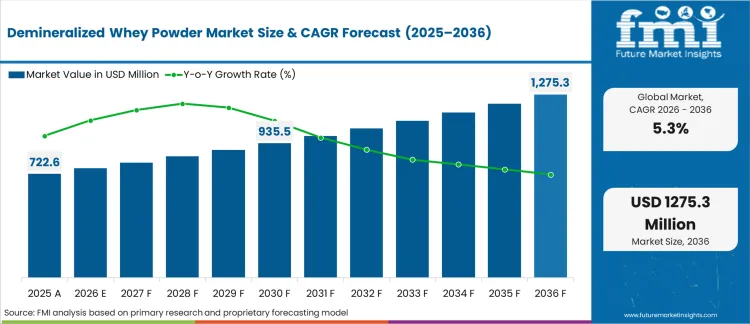
The global demineralized whey powder market is witnessing steady structural expansion, propelled by rising early-life nutrition demand and stricter mineral-load specifications in pediatric formulations. According to Future Market Insights (FMI), global sales stood at USD 722.6 million in 2025 and are projected to reach USD 760.9 million in 2026. Over the forecast period from 2026 to 2036, revenues are expected to advance to USD 1,267.2 million, reflecting a CAGR of 5.3%.
Growth is closely tied to sustained capital deployment in electrodialysis and ion-exchange systems across major dairy-producing economies, enabling processors to meet increasingly stringent mineral reduction benchmarks required in infant and clinical nutrition.
Demineralized whey powder represents refined dairy solids with controlled ash reduction, primarily used in infant formula, specialized medical nutrition, and selected functional food applications. The ingredient retains high lactose and soluble protein content while limiting inorganic salt levels to comply with osmolality standards critical for neonatal renal tolerance.
Procurement specifications are reshaping demand baselines. Regulatory references from the U.S. Food and Drug Administration indicate that refined inputs can deliver up to 90% mineral removal, reinforcing the need for verifiable, standardized demineralization performance. Buyers increasingly require documented mineral reduction profiles—40%, 70%, or 90%—to align with application-specific nutritional claims.
Segmental Outlook: Mid-Range Demineralization Dominates
Grades delivering 40% to 90% mineral removal account for 62.4% of global value share in 2026. These variants balance cost-efficiency with functional performance, making them suitable for infant follow-on formulas, confectionery, and dairy blends.
Processors prioritize mid-level demineralization because it meets osmolality thresholds without incurring the highest energy intensity associated with ultra-refined 90%+ variants. Hybrid membrane systems combining nanofiltration and electrodialysis are increasingly deployed to improve yields and reduce utilities expenditure per metric ton.
By application, infant nutrition remains the cornerstone of demand, representing 45% of total volume in 2026. Neonatal formulations depend on tightly regulated mineral profiles to prevent renal overload and to replicate human milk composition benchmarks. Early-stage formula recipes may incorporate substantial whey powder inclusion rates, sustaining long-term procurement contracts between processors and multinational baby food brands.
Recent strategic moves highlight consolidation and capacity upgrades. Arla Foods Ingredients signed an agreement to acquire Volac’s Whey Nutrition business, strengthening its pediatric-grade supply capabilities. Similarly, Lactalis Ingredients inaugurated a new drying tower backed by a EUR 16 million modernization investment to enhance output efficiency and quality consistency.
Regional Growth Dynamics
India’s expansion is underpinned by rising domestic milk production, which reached 239.2 million tonnes, according to data released by the Press Information Bureau. Abundant raw material availability is encouraging processors to invest in higher-value fractionation infrastructure.
China continues to scale localized capacity to reduce reliance on imports for ultra-refined grades. USDA FAS GAIN reports highlight commissioning of new capacity lines aimed at substituting foreign ingredients while meeting domestic formula standards.
In North America, the United States is projected to grow at 5.4% CAGR as processors modernize facilities to align with FDA-compliant mineral reduction guidelines. Export-oriented production and strict traceability requirements further reinforce demand for highly refined variants exceeding 90% demineralization.
Europe remains a global export powerhouse due to cooperative scale and advanced processing expertise. The European Commission approved a major merger between FrieslandCampina and Milcobel, consolidating significant processing capacity and reinforcing Europe’s influence over global pricing and supply standards.
Market Drivers, Restraints, and Opportunities
Rising global milk output supports raw material availability. The Food and Agriculture Organization projects global milk production to reach 979 million tonnes, creating substantial precursor volumes for whey valorization.
However, broader breastfeeding adoption moderates overall infant formula volume growth. The World Health Organization reports that 48% of infants globally benefit from exclusive breastfeeding, constraining total formula expansion. In response, manufacturers are premiumizing formulations, increasing demand for highly refined and neutral-tasting dairy inputs.
Opportunities are emerging in clinical nutrition, aging populations, and import substitution strategies across Asia-Pacific and Latin America. Brazil, producing over 35 billion liters of milk annually, is upgrading domestic processing to capture higher-margin ingredient exports.
Competitive Landscape
The competitive environment features leading dairy cooperatives and global ingredient specialists, including:
- Arla Foods Ingredients
- Lactalis Ingredients
- FrieslandCampina
- Valio
- Euroserum
- Saputo
- Glanbia Nutritionals
- Fonterra
- Dairygold
Scale, traceability, and compliance capability remain decisive competitive levers. Infant-grade supply chains demand full backward integration verification, microbiological safety controls, and precise mineral tolerance validation.
👉 Get Access to the Report Sample:
Research Methodology
FMI’s forecast integrates primary interviews with dairy cooperative executives, pediatric formulators, and separation technology vendors. Base-year modeling triangulates global milk production statistics with infant formula manufacturing capacities. The study excludes standard sweet whey powder, high-protein isolates not undergoing demineralization, and retail-ready finished consumer goods.
Frequently Asked Questions (FAQ)
How large is the market in 2026?
It is valued at USD 760.9 million.
What will the market size be by 2036?
It is projected to reach USD 1,267.2 million.
What is the growth rate from 2026 to 2036?
The market is expected to grow at a CAGR of 5.3%.
Which product grade leads sales?
40%–90% demineralized variants hold the dominant share due to cost-performance balance.
What drives demand most strongly?
Infant nutrition manufacturing, stricter mineral-load compliance, and investments in advanced electrodialysis infrastructure.
Why FMI: https://www.futuremarketinsights.com/why-fmi
Related Reports:
- Brewer's Yeast Market https://www.futuremarketinsights.com/reports/brewers-yeast-market
- Oral Clinical Nutrition Supplement Market https://www.futuremarketinsights.com/reports/oral-clinical-nutrition-supplements-market
- Herbs and Spices Market https://www.futuremarketinsights.com/reports/herbs-and-spices-market
- Potato Flakes Market https://www.futuremarketinsights.com/reports/potato-flake-market
About Future Market Insights (FMI)
Future Market Insights (FMI) is a leading provider of market intelligence and consulting services, serving clients in over 150 countries. Headquartered in Delaware, USA, with a global delivery center in India and offices in the UK and UAE, FMI delivers actionable insights to businesses across industries including automotive, technology, consumer products, manufacturing, energy, and chemicals.
An ESOMAR-certified research organization, FMI provides custom and syndicated market reports and consulting services, supporting both Fortune 1,000 companies and SMEs. Its team of 300+ experienced analysts ensures credible, data-driven insights to help clients navigate global markets and identify growth opportunities.
Contact Us:
Future Market Insights Inc.
Christiana Corporate, 200 Continental Drive,
Suite 401, Newark, Delaware - 19713, USA
T: +1-347-918-3531
For Sales Enquiries: sales@futuremarketinsights.com