English
 Arabic
 French
 Spanish
 Portuguese
 Deutsch
 Turkish
 Dutch
Dutch
 Italiano
 Russian
 Romaian
 Portuguese (Brazil)
 Greek
Greek
Food Safety Testing Services Market Outlook
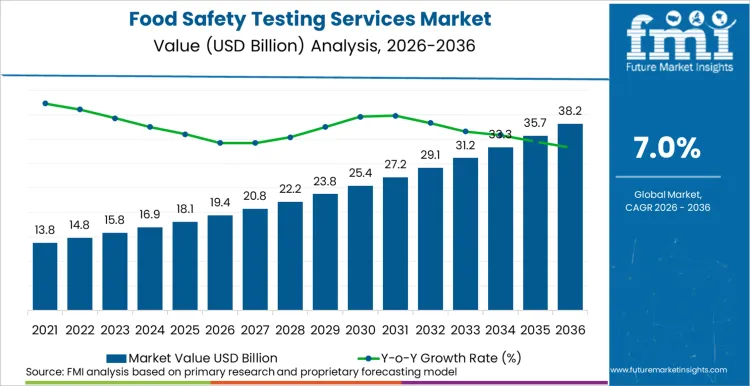
The global food safety testing services market is entering a phase of strong and sustained expansion as regulatory scrutiny and international food trade continue to grow. According to new industry analysis by Future Market Insights, the market was valued at USD 18.1 billion in 2025 and is expected to reach USD 19.4 billion in 2026. Over the next decade, the industry is projected to nearly double, reaching USD 38.2 billion by 2036 and expanding at a compound annual growth rate (CAGR) of 7.0%.
This increase represents an absolute dollar growth of USD 18.8 billion, highlighting the escalating importance of food safety infrastructure as supply chains become more complex and globally interconnected.
Global Food Trade Driving Testing Demand
The rapid expansion of international food trade has significantly increased the need for rigorous testing services across multiple stages of the supply chain. As food products move across borders in larger volumes and at faster speeds, regulators and industry players are intensifying testing protocols to ensure product safety and compliance with national and international standards.
Food safety testing services are now an essential safeguard against contamination, spoilage, and mislabeling. Manufacturers, exporters, and retailers rely on third-party laboratories to verify compliance with safety requirements before products reach consumers.
The rising complexity of global supply chains has also increased the risk of contamination from pathogens, chemical residues, and allergens. This risk environment is pushing companies to expand routine testing and invest in advanced detection technologies.
Regulatory Surveillance Networks Expanding Worldwide
Governments and international food safety agencies are strengthening surveillance frameworks to prevent foodborne outbreaks and protect public health. As a result, compliance requirements for food producers are becoming more stringent and comprehensive.
Testing services are being used to monitor a wide range of potential hazards, including:
- Microbial contamination such as salmonella and listeria
- Chemical residues including pesticides and heavy metals
- Allergens and undeclared ingredients
- Genetically modified organism (GMO) presence
- Food authenticity and adulteration
These testing requirements are becoming mandatory across numerous markets, forcing food manufacturers to conduct regular laboratory assessments throughout production, processing, packaging, and distribution stages.
Preventing Recalls and Protecting Brand Reputation
One of the most significant drivers behind increased testing frequency is the financial and reputational damage caused by product recalls. A single contamination incident can trigger large-scale recalls that cost companies millions of dollars and erode consumer trust.
Food safety testing services provide a proactive layer of protection, enabling manufacturers to identify potential hazards before products enter the retail chain. Early detection allows companies to resolve issues quickly, preventing costly disruptions and regulatory penalties.
As consumer awareness of food safety grows, companies are also recognizing the value of transparent quality assurance practices. Third-party testing certifications are increasingly used as a trust-building mechanism for brands operating in competitive markets.
Technological Advancements Improving Detection Capabilities
The food safety testing services industry is benefiting from rapid technological innovation. Advanced diagnostic tools and automated laboratory systems are improving detection speed, accuracy, and scalability.
Modern testing laboratories are adopting technologies such as rapid microbial detection systems, polymerase chain reaction (PCR) methods, and next-generation sequencing to identify contaminants with higher precision.
Automation and digital data management are also improving testing workflows, enabling laboratories to process higher sample volumes while maintaining strict quality standards.
These advancements are particularly important as global food production increases and regulatory authorities demand faster turnaround times for safety verification.
Regional Market Trends Highlight Strong Growth Potential
North America remains one of the largest markets for food safety testing services due to stringent regulatory frameworks and advanced laboratory infrastructure. Government agencies and industry organizations have established strict testing protocols that continue to drive demand for third-party verification services.
Europe also represents a significant share of the global market, supported by comprehensive food safety regulations and strong consumer protection policies. European food producers must comply with strict traceability and labeling requirements, increasing the need for laboratory validation.
Meanwhile, the Asia Pacific region is expected to record the fastest growth during the forecast period. Rapid industrialization of food production, expanding export markets, and rising consumer awareness around food safety are accelerating demand for testing services across emerging economies.
Countries with large agricultural and food processing sectors are investing heavily in laboratory capabilities to meet international export standards.
👉 Get Access to the Report Sample:
Outlook: Testing Services Become a Core Pillar of Food Supply Chains
With the market projected to grow from USD 18.1 billion in 2025 to USD 38.2 billion by 2036, food safety testing services are evolving from a regulatory requirement into a fundamental component of modern food supply chains.
Several long-term trends are expected to sustain growth:
- Expansion of global food trade networks
- Increasing regulatory compliance requirements
- Growing consumer demand for food transparency
- Rising risk of contamination in complex supply chains
- Technological advancements in testing methodologies
As food systems become more globalized and consumers demand higher safety standards, testing services will continue to play a critical role in protecting public health and maintaining confidence in the global food industry.
Industry experts believe that companies investing early in comprehensive testing programs and advanced detection technologies will be better positioned to navigate evolving regulatory landscapes and build stronger brand credibility in the years ahead.
Why FMI: https://www.futuremarketinsights.com/why-fmi
Related Reports:
About Future Market Insights (FMI)
Future Market Insights (FMI) is a leading provider of market intelligence and consulting services, serving clients in over 150 countries. Headquartered in Delaware, USA, with a global delivery center in India and offices in the UK and UAE, FMI delivers actionable insights to businesses across industries including automotive, technology, consumer products, manufacturing, energy, and chemicals.
An ESOMAR-certified research organization, FMI provides custom and syndicated market reports and consulting services, supporting both Fortune 1,000 companies and SMEs. Its team of 300+ experienced analysts ensures credible, data-driven insights to help clients navigate global markets and identify growth opportunities.
Contact Us:
Future Market Insights Inc.
Christiana Corporate, 200 Continental Drive,
Suite 401, Newark, Delaware - 19713, USA
T: +1-347-918-3531
For Sales Enquiries: sales@futuremarketinsights.com