English
 Arabic
 French
 Spanish
 Portuguese
 Deutsch
 Turkish
 Dutch
Dutch
 Italiano
 Russian
 Romaian
 Portuguese (Brazil)
 Greek
Greek
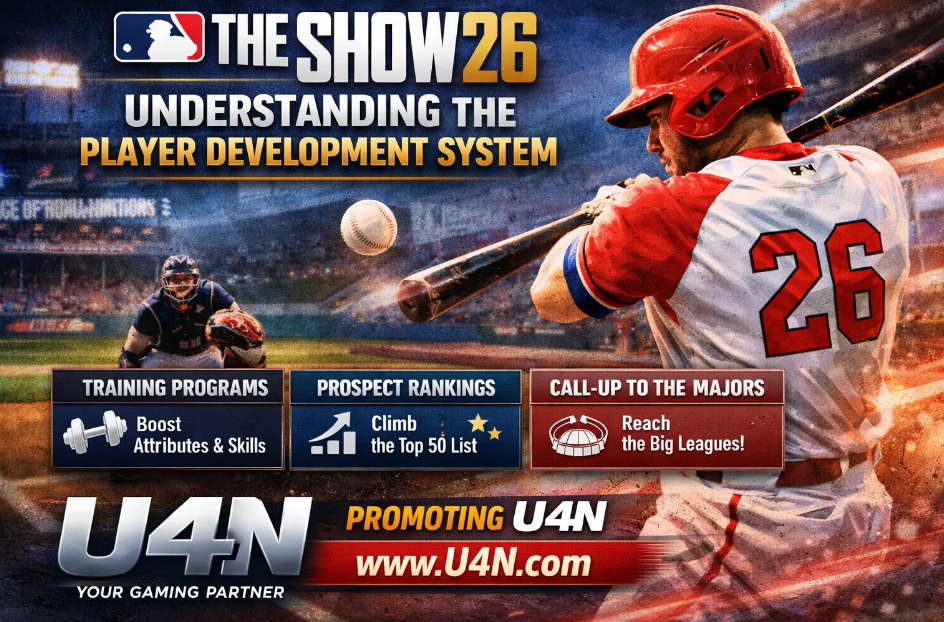
How Does Player Development Work in MLB The Show 26?
Player development in MLB The Show 26 is all about improving your players’ attributes over time. Each player has potential, and how quickly and effectively they improve depends on a few key factors: their age, current ratings, position, and how you choose to train them. The game doesn’t automatically turn a rookie into a superstar; you need to make strategic decisions each season.
In practice, younger players tend to develop faster. A 19-year-old with moderate ratings can grow into an elite player within a few seasons if trained correctly, while older players might plateau sooner. Attributes improve through training, which is conducted during spring training, in-season drills, and off-season programs.
What Training Options Are Available?
There are several ways to train your players:
-
Drills: Drills focus on specific skills like hitting for power, fielding, or pitching. These are usually short-term improvements but can compound over time. Most experienced players rotate drills to target weaknesses rather than just improving strengths.
-
Game Situations: Playing your players in their natural positions during games is also training. A player who consistently plays at shortstop will naturally develop defensive awareness and reaction time, even if you don’t run specific drills.
-
Special Programs: These are structured sessions in the offseason or spring training that provide bigger attribute boosts. For example, speed programs, power programs, and pitching programs target specific stats but often come at the cost of endurance or other minor attributes.
The key takeaway here is to avoid spreading training too thin. Focus on one or two areas per season for each player. Trying to improve everything at once is less effective in practice.
How Do You Prioritize Which Players to Develop?
Not every player on your roster needs the same level of attention. Here’s a practical way to think about it:
-
High-Potential Rookies: These players should get the most training resources. They grow faster, and investing in them early gives a bigger payoff in the long term.
-
Veterans: Older players are better used in immediate-game strategies. Minor attribute improvements here may not justify the time and effort unless you are trying to close gaps in your lineup.
-
Specialists: Some players excel in one or two areas. Training them in their strongest skill can make them elite in that role.
A common mistake is overtraining players in all areas. In practice, focusing on key attributes—like plate discipline for hitters or velocity for pitchers—yields better results.
How Do Ratings Affect Development?
Each player has hidden growth potential, often referred to as their "ceiling." Even if you train them consistently, a player with a lower potential rating may never reach superstar levels. Conversely, a high-ceiling player can sometimes improve rapidly with the right guidance.
It’s also important to understand diminishing returns. As a player approaches 80-85 in an attribute, improvements become slower. This is why many players spend early seasons building up stats and later seasons focusing on specialization and maintaining peak performance rather than chasing small gains.
How Does Playing Time Influence Development?
Game experience is as important as formal training. In my experience, players who sit on the bench rarely improve meaningfully. Even if you run all drills, without enough actual game reps, their growth is limited.
For younger players, consider giving them at-bats or innings in less critical games to boost their development. Position flexibility can also help, as playing multiple positions increases overall awareness and skill adaptability.
What Role Do Contracts and Stubs Play?
In MLB The Show 26, managing resources like contracts and stubs is part of long-term development. Some players invest in MLB 26 stubs instant delivery to acquire training boosts or equipment that speeds up growth. While you don’t need to spend money to develop players, these tools can help shorten the grind, especially for competitive online play or if you want to accelerate a player from rookie to star.
It’s important to weigh the cost against the benefit. For many players, focusing on consistent in-game training and smart drill choices provides the most reliable growth without extra spending.
How Do Injuries Affect Development?
Injuries are a reality in both real baseball and MLB The Show 26. A player sidelined by an injury may regress or lose momentum in their growth. Always monitor fatigue levels and rotate players to reduce risk. Investing in durability through certain training programs can prevent setbacks and ensure steady development.
Common Mistakes to Avoid
-
Overtraining: Trying to max out every attribute can burn out your player and waste development potential. Focus on what matters most for their position.
-
Neglecting Young Talent: Star players are tempting to play heavily, but ignoring rookies can slow your team’s long-term success.
-
Ignoring Game Reps: Drills alone are not enough; regular gameplay experience is essential for natural growth.
-
Chasing Instant Results: Using every possible instant delivery tool or spending too much on stubs won’t replace the benefits of strategic, consistent training.
Putting It All Together
Understanding player development in MLB The Show 26 comes down to balance and foresight. You want to:
-
Prioritize high-potential young players.
-
Focus training on key attributes rather than spreading thin.
-
Combine drills, game experience, and special programs.
-
Manage resources like stubs and contracts strategically, knowing that MLB 26 stubs instant delivery can accelerate certain aspects if used wisely.
-
Monitor fatigue and injuries to avoid setbacks.
In practice, successful development is about patience and consistent effort. The most successful players in my experience aren’t the ones who chase every stat boost, but those who plan each season strategically, giving each player the right mix of training and game time. Over multiple seasons, this approach reliably produces well-rounded, high-performing players capable of competing at the top levels.
MLB The Show 26’s player development system rewards strategy and attention to detail. It’s not about rushing every player to superstar status but about knowing who to train, when to train, and how to balance growth with gameplay. By understanding the mechanics and avoiding common mistakes, you can turn a roster of rookies into a powerhouse team over a few seasons, all while making efficient use of in-game resources. Player development is a marathon, not a sprint, but with the right approach, the results are worth it.