English
 Arabic
 French
 Spanish
 Portuguese
 Deutsch
 Turkish
 Dutch
Dutch
 Italiano
 Russian
 Romaian
 Portuguese (Brazil)
 Greek
Greek
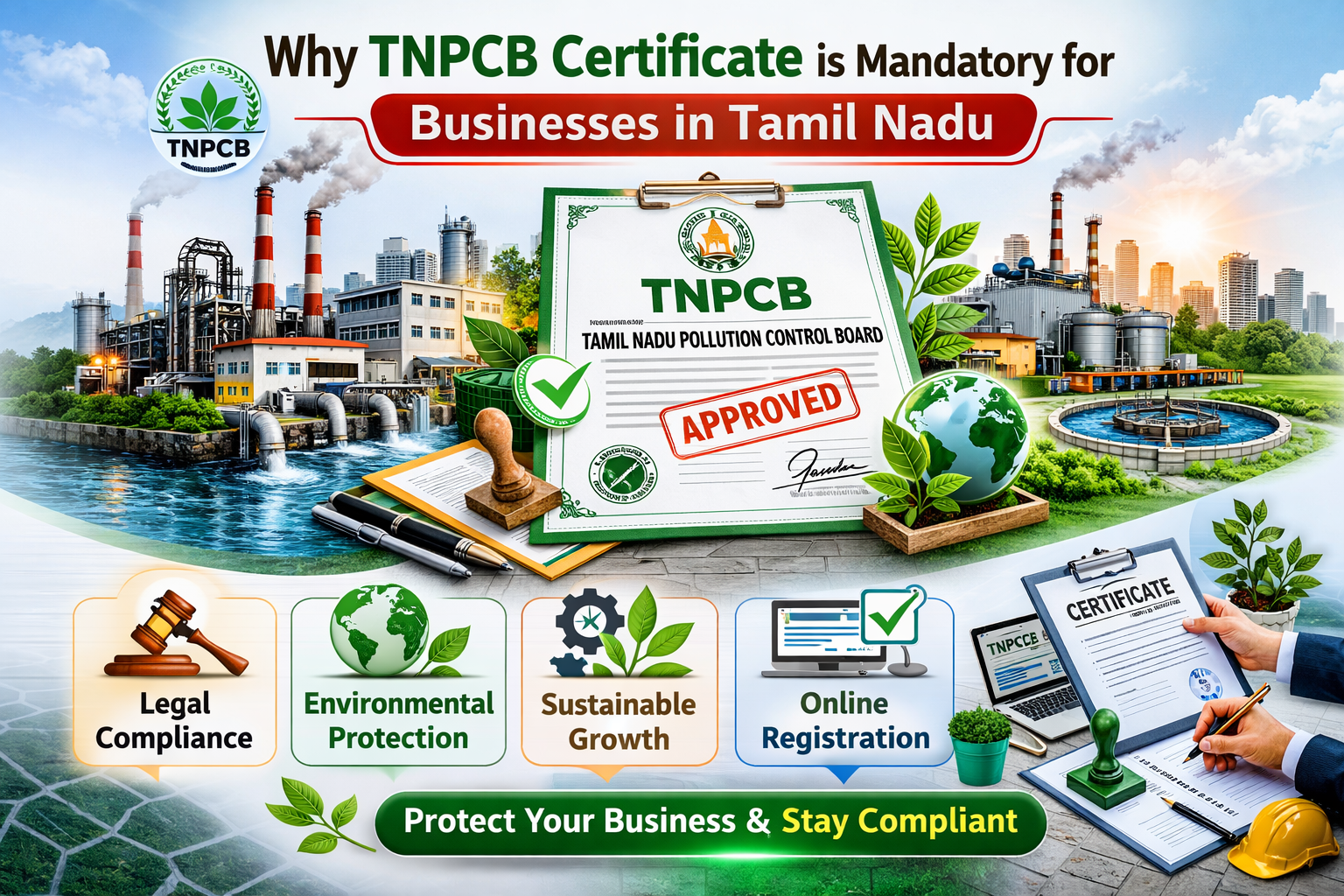
Starting or operating a business in Tamil Nadu requires compliance with environmental regulations set by the Tamil Nadu Pollution Control Board (TNPCB). One of the most essential approvals is the TNPCB Certificate, also known as Consent to Establish (CTE) and Consent to Operate (CTO). Whether you are running a small unit or a large-scale industry, obtaining this certification is not just a legal requirement but also a step toward sustainable and responsible business operations.
What is TNPCB Certificate?
The TNPCB certificate is an official authorization issued by the Tamil Nadu Pollution Control Board to ensure that industries and businesses comply with environmental norms. It regulates air, water, and noise pollution levels and ensures that businesses do not harm the environment or public health.
Through TNPCB online registration, businesses can apply for approvals without visiting government offices physically, making the process faster and more transparent.
Why is TNPCB Certificate Mandatory?
1. Legal Compliance with Environmental Laws
The TNPCB operates under key environmental acts such as the Water (Prevention and Control of Pollution) Act, 1974 and the Air (Prevention and Control of Pollution) Act, 1981. Any business that generates waste, emissions, or pollutants must obtain clearance from the tamilnadu pollution control board. Operating without this certificate can lead to heavy penalties, closure notices, or legal action.
2. Mandatory for Business Setup and Expansion
Before starting construction or installing machinery, businesses must obtain Consent to Establish (CTE). Similarly, before commencing operations, Consent to Operate (CTO) is required. Without these approvals from TNPCB, businesses cannot legally function or expand their operations.
3. Environmental Protection and Sustainability
The primary goal of TNPCB is to protect the environment. By making the TNPCB certificate mandatory, the board ensures that industries adopt pollution control measures such as waste management systems, emission control devices, and water treatment plants. This contributes to sustainable industrial growth in Tamil Nadu.
4. Builds Trust and Business Credibility
Having a valid TNPCB certificate enhances your brand image and builds trust among customers, investors, and stakeholders. It shows that your business follows ethical practices and complies with environmental standards.
5. Required for Licenses and Approvals
Many other government approvals, such as factory licenses, trade licenses, and bank loans, require TNPCB clearance. Without this certificate, businesses may face delays or rejection in obtaining other necessary permits.
TNPCB Online Registration Process
The government has simplified the application process through tnpcb online registration. Here’s a brief overview:
- Visit the official TNPCB portal
- Register your business details
- Submit required documents (ID proof, land documents, project report, etc.)
- Pay the applicable fees
- Track application status online
This digital system saves time and reduces paperwork, making compliance easier for businesses.
Comparison with Kerala Pollution Control Board
While Tamil Nadu follows TNPCB regulations, neighboring states like Kerala have their own authorities such as the Kerala Pollution Control Board. Although the core objective remains the same—environmental protection—each board has its own procedures and compliance requirements.
For businesses operating in multiple states, it is important to understand the differences in application processes, documentation, and timelines between TNPCB and the kerala pollution control board.
Who Needs TNPCB Certificate?
The TNPCB certificate is required for:
- Manufacturing industries
- Food processing units
- Chemical plants
- Hospitals and clinics
- Hotels and restaurants
- Small and medium enterprises (SMEs)
Even small-scale businesses that generate minimal pollution must obtain clearance depending on their category (Red, Orange, Green, or White).
Consequences of Not Having TNPCB Certificate
Operating without TNPCB approval can result in:
- Heavy fines and penalties
- Sealing or closure of business
- Legal notices and prosecution
- Damage to business reputation
Hence, it is always advisable to complete TNPCB online registration before starting operations.
Final Thoughts
In today’s environmentally conscious world, compliance is not optional—it is essential. The TNPCB certificate ensures that businesses in Tamil Nadu operate responsibly while protecting natural resources and public health. From legal compliance to brand credibility, the benefits of obtaining this certificate are significant.
If you are planning to start or expand your business, make sure to apply through TNPCB online registration and stay compliant with the tamilnadu pollution control board regulations. By doing so, you not only avoid legal risks but also contribute to a cleaner and greener future.