 English
 Arabic
 French
 Spanish
 Portuguese
 Deutsch
 Turkish
 Dutch
Dutch
 Italiano
 Russian
 Romaian
 Portuguese (Brazil)
 Greek
Greek
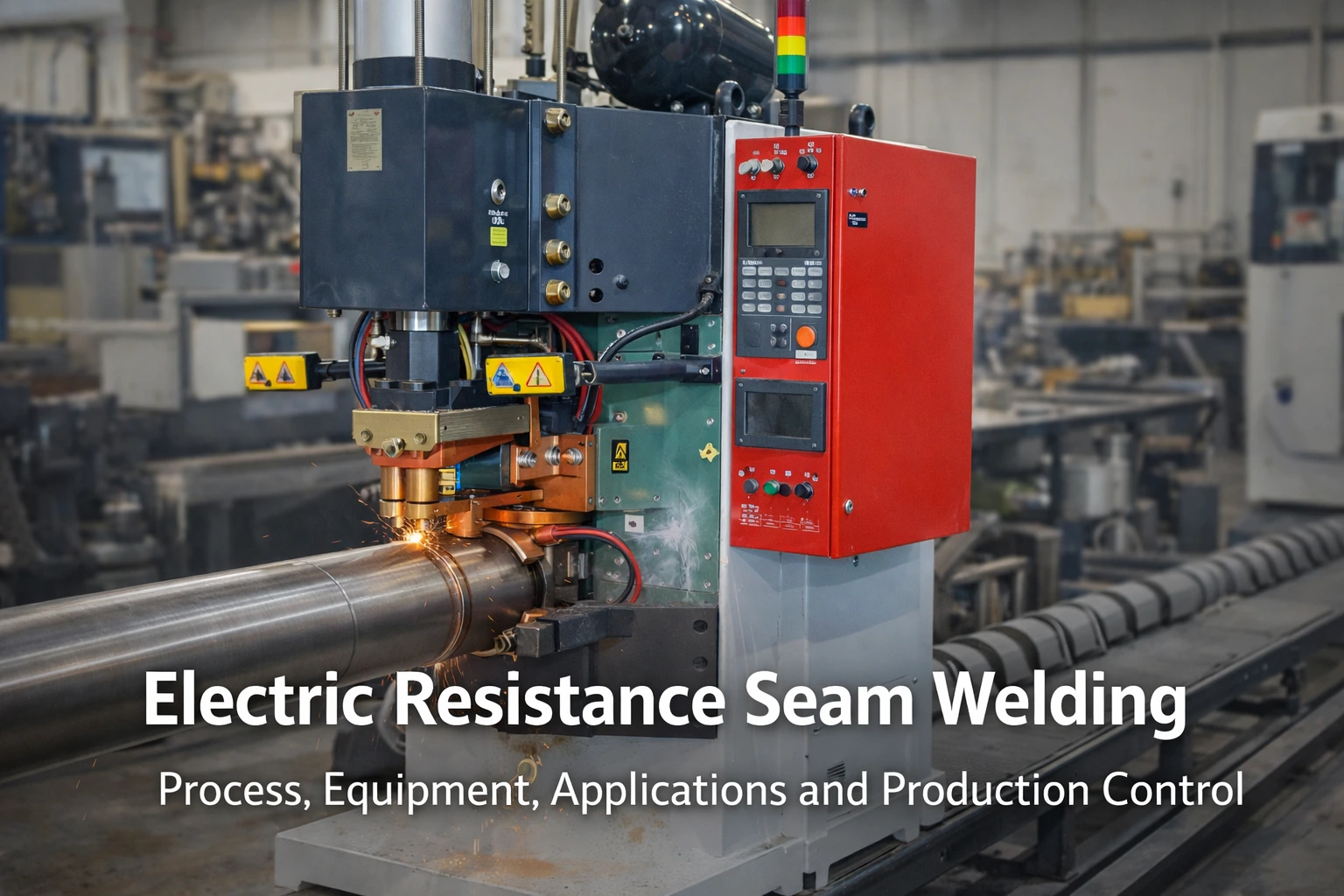
In today’s fast-paced manufacturing landscape, achieving consistent, high-quality metal joining is critical. Electric resistance welding (ERW) stands out as a versatile and efficient technology widely adopted by OEMs, automation integrators, and factory decision-makers for its speed, precision, and adaptability. At Heron Welder, we provide state-of-the-art electric resistance welding machines and automation solutions designed to optimize production, reduce costs, and deliver reliable results across industries.
What is Electric Resistance Welding?
Electric resistance welding is a metal-joining process that uses electric current and pressure to create a weld. Unlike fusion welding, ERW does not require external filler materials or flames. The core principle involves passing a controlled electrical current through the interface of the metals to be joined. The resistance of the metals to the current generates localized heat, causing the material to soften and fuse under pressure applied by welding electrodes.
This process offers multiple advantages for industrial manufacturing:
-
High repeatability and precision – ideal for automated production lines.
-
Fast welding cycles – increases throughput in high-volume applications.
-
Material versatility – works with steel, aluminum, copper, and other conductive metals.
-
Clean operation – minimal smoke, spatter, or post-weld finishing.
Heron’s portfolio includes spot, projection, seam, MFDC, and capacitor discharge welding machines, ensuring the right solution for any production challenge.
Key Types of Electric Resistance Welding
1. Spot Welding
Spot welding is the most common ERW method. Electrodes apply pressure while current flows through overlapping sheets, creating a small molten nugget that solidifies to form a strong joint.
Applications: automotive body panels, metal furniture, battery tabs.
2. Projection Welding
In projection welding, raised sections on the metal workpieces concentrate the current and heat at specific points. This allows for multiple simultaneous welds, reducing cycle times and ensuring consistent quality.
Applications: fastening nuts, bolts, and clips to metal plates, electrical assemblies.
3. Seam Welding
Seam welding produces a continuous weld along the edges of overlapping materials using rotating wheel electrodes. This process is ideal for creating leak-proof or pressure-tight assemblies.
Applications: fuel tanks, metal drums, HVAC ducting.
4. Capacitor Discharge & MFDC Welding
Capacitor discharge and medium-frequency direct current (MFDC) welding deliver precise, high-energy pulses for thin or delicate materials. These methods minimize thermal distortion while ensuring strong, localized welds.
Applications: battery packs, electronic components, thin sheet metals.
Advantages of Electric Resistance Welding for Industrial Manufacturing
Electric resistance welding offers compelling benefits for factory decision-makers looking to optimize efficiency and product quality:
-
Automation-friendly: ERW machines integrate seamlessly into robotic lines, reducing labor dependency and increasing production consistency.
-
Energy-efficient: localized heating minimizes energy consumption compared to traditional fusion welding.
-
Low maintenance: fewer moving parts and no consumable electrodes in some systems reduce downtime.
-
Enhanced safety: absence of open flames and fumes lowers workplace hazards.
At Heron, we design machines and automated solutions tailored for industrial-scale manufacturing, ensuring optimal performance while addressing specific production requirements.
Best Practices for Electric Resistance Welding
To maximize the benefits of ERW, manufacturers should follow key best practices:
-
Material Preparation: Clean, aligned, and properly tinned surfaces ensure consistent welds.
-
Optimal Electrode Selection: Correct electrode shape, material, and tip maintenance are critical for quality and longevity.
-
Parameter Control: Current, pressure, and weld time must be precisely controlled for each material type and thickness.
-
Regular Monitoring: Integrating process monitoring and quality assurance systems reduces defects and scrap rates.
-
Automation Integration: Incorporating robotic arms or conveyor systems enhances repeatability, throughput, and worker safety.
Heron Welder offers expert guidance and custom automation solutions to help manufacturers implement these best practices effectively.
Electric Resistance Welding vs. Other Welding Methods
| Feature | Electric Resistance Welding | MIG Welding | TIG Welding | Laser Welding |
|---|---|---|---|---|
| Heat Source | Electrical resistance | Arc | Arc | Laser beam |
| Speed | Very high | Moderate | Slow | Very high |
| Material Thickness | Thin to medium | Medium to thick | Thin to medium | Thin to thick |
| Automation | Highly automation-friendly | Moderate | Low | High |
| Quality | High, repeatable | Moderate | Very high | Very high |
ERW is often the preferred choice for high-volume production where speed, repeatability, and energy efficiency are critical.
FAQs about Electric Resistance Welding
1. What metals can be welded using ERW?
ERW is suitable for steel, stainless steel, aluminum, copper, and other conductive metals. Material conductivity and thickness determine the optimal welding method.
2. Is ERW suitable for automated production lines?
Absolutely. ERW machines are designed for robotic integration and automated workflows, making them ideal for high-volume manufacturing.
3. How do I maintain electrode life in spot welding?
Regular cleaning, reshaping, and selecting the correct electrode material ensure consistent weld quality and extended electrode life.
4. Can ERW be used for battery assembly?
Yes. Capacitor discharge and MFDC resistance welding are widely used for battery tabs and delicate electronic assemblies.
5. How does Heron support custom welding solutions?
Heron offers consultation, custom machine design, and automated line integration to meet unique production requirements for OEMs and manufacturers worldwide.
Partner with Heron for Electric Resistance Welding Excellence
Implementing electric resistance welding correctly can transform production efficiency, product quality, and profitability. At Heron Welder, we combine innovative machinery, expert consulting, and automation expertise to deliver tailored solutions for your manufacturing needs.
Whether you require spot, projection, seam, MFDC, or capacitor discharge welding, our global team of experts ensures your operations achieve maximum performance, precision, and reliability.
Request a quote or consult with Heron today to explore customized electric resistance welding solutions that elevate your manufacturing capabilities.
