English
 Arabic
 French
 Spanish
 Portuguese
 Deutsch
 Turkish
 Dutch
Dutch
 Italiano
 Russian
 Romaian
 Portuguese (Brazil)
 Greek
Greek
Vector Facelift vs. Traditional Facelift: Key Differences Explained
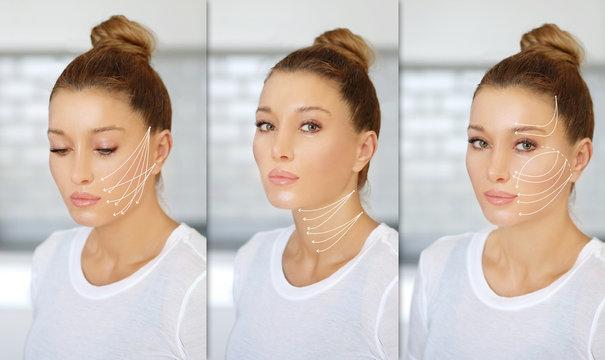
The landscape of facial rejuvenation has evolved significantly over the past several decades, moving from simple skin tightening to complex structural remodeling. For individuals considering a Vector Facelift in Riyadh, understanding the scientific and technical distinctions between this modern approach and the traditional facelift is essential. While both procedures aim to reduce the visible signs of aging, they operate on different anatomical planes and follow different geometric principles. The traditional method often focused on a lateral pull of the skin to smooth out wrinkles, whereas the vector approach focuses on the vertical repositioning of deep facial tissues. This shift in philosophy has revolutionized the industry, allowing specialists in the capital to provide results that are not only more durable but significantly more natural in appearance, avoiding the "over-operated" look that was common in previous eras.
1. The Direction of the Lift: Horizontal vs. Vertical
The most fundamental difference between these two procedures lies in the direction, or "vector," of the surgical pull.
-
Traditional Facelift: Historically, surgeons focused on a horizontal or diagonal vector. By pulling the skin toward the ears and hairline, they could effectively tighten the jawline and smooth the cheeks. However, because the face naturally sags downward due to gravity, a horizontal pull does not actually reverse the aging process—it simply stretches the tissue across it. This often resulted in a widened mouth and a flattened mid-face.
-
Vector Facelift: The modern vector approach utilizes a vertical orientation. Specialists identify the exact path of gravitational descent and lift the tissues directly upward. This restores the volume to the high cheekbones and corrects jowls by moving the fallen tissue back to its original home, rather than stretching it toward the ears.
2. Anatomical Target: Skin vs. Deep Structural Layers
The "depth" of the procedure is another major point of divergence.
-
Traditional Facelift: Early facelifts were largely "skin-only" (cutaneous) procedures. The surgeon would undermine a large area of skin, pull it tight, and trim the excess. Because skin is elastic, it eventually stretches back out, often leading to a loss of results within just a few years. Furthermore, placing tension on the skin can cause scarring to widen or pull the earlobes downward (the "pixie ear" deformity).
-
Vector Facelift: This technique targets the SMAS (Superficial Musculoaponeurotic System) or even the deep plane beneath the muscles. By repositioning the fibrous and muscular layers of the face, the surgeon creates a sturdy internal scaffold. The skin is then simply "redraped" over this new foundation without any tension. Because the deep layers do not stretch like skin does, the results are much more permanent.
3. The Appearance of the Mid-Face and Cheeks
The mid-face is often the "tell-tale" sign of a facelift’s quality.
-
Traditional Methods: Because of the lateral pull, traditional facelifts often resulted in a loss of cheek projection. The face could appear "two-dimensional" or hollowed out in the center while being tight at the edges.
-
Vector Methods: By lifting the malar fat pads vertically, the vector facelift restores the natural "S-curve" or "Ogee curve" of the cheek when viewed from the side. This creates a plump, youthful fullness in the mid-face without the need for excessive dermal fillers, as the patient's own natural fat is moved back into a higher position.
4. Incision Placement and Scarring
The way incisions are managed has also seen a technological leap.
-
Traditional Facelift: Traditional incisions were often long, extending far into the hairline and around the back of the ear. Because the skin was pulled tight, the tension often caused the scars to become thick or pale over time.
-
Vector Facelift: Because the tension is handled by the deep internal sutures, the skin incisions are under zero stress. This allows them to heal into nearly invisible, hair-thin lines. Many vector lifts utilize "short-scar" techniques (often called the MACS lift or mini-vector lift), where the incision is hidden entirely in the natural crease in front of the ear, making it virtually undetectable even with hair pulled back.
5. Recovery Time and Surgical Trauma
The experience of the patient during the healing phase differs due to the level of tissue disruption.
-
Traditional Facelift: These procedures often involved extensive "undermining" (separating the skin from the muscle), which disrupted many small blood vessels and lymphatic channels. This led to significant bruising, prolonged swelling, and sometimes a "numb" feeling that lasted for months.
-
Vector Facelift: By working in specific "bloodless planes" of the face, modern surgeons minimize trauma. The vertical vector approach requires less skin separation, which preserves the blood supply and lymphatic drainage. Most patients in Riyadh find they can return to social activities within 10 to 14 days, as the initial swelling subsides much faster than with older techniques.
6. Longevity of Results
How long a facelift lasts is a primary concern for any patient.
-
Traditional Facelift: Most skin-only or limited-tension facelifts provide results for roughly 5 to 7 years before the skin begins to sag again.
-
Vector Facelift: Because the underlying architecture of the face has been physically moved and secured, a vector facelift typically lasts between 10 and 15 years. The patient continues to age, but they do so from a significantly "reset" starting point.
Summary Table: At a Glance
| Feature | Traditional Facelift | Vector Facelift |
| Primary Vector | Horizontal / Lateral | Vertical / Upward |
| Main Layer | Skin (Cutaneous) | SMAS / Deep Plane |
| Mid-Face Effect | Often flattens cheeks | Restores cheek volume |
| Incision Tension | High (leads to wider scars) | Low (leads to invisible scars) |
| Natural Look | Risk of "wind-swept" look | High (preserves original features) |
| Average Longevity | 5–7 years | 10–15 years |
Conclusion
The choice between a vector facelift and a traditional facelift is ultimately a choice between "stretching" and "restoring." While traditional methods paved the way for modern aesthetics, the science of the vector lift has refined the process to meet the high standards of today's discerning patients. By focusing on the deep anatomy and the vertical nature of aging, specialists are able to provide a rejuvenation that is as durable as it is beautiful. For those seeking to refresh their appearance while maintaining the integrity of their natural look, the vertical vector approach stands as the clear superior choice in the modern era of aesthetic surgery.