English
 Arabic
 French
 Spanish
 Portuguese
 Deutsch
 Turkish
 Dutch
Dutch
 Italiano
 Russian
 Romaian
 Portuguese (Brazil)
 Greek
Greek
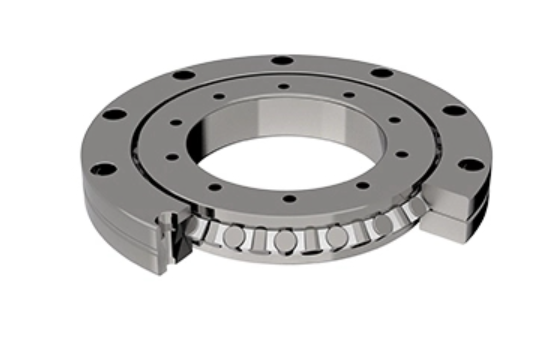
High-precision rotary tables often suffer from "uneven torque" during operation. In my years on the factory floor, I have seen how a single overtightened bolt can warp the thin rings of an RU cross roller bearing instantly.
The integrated inner and outer ring design is meant to simplify mounting, but it demands a perfectly flat support surface. If your mounting base has even a microscopic bow, the bearing will bind, causing jerky robotic movements.
As an experienced manufacturer, I recommend checking your housing tolerances before every installation. Achieving sub-micron accuracy requires a delicate balance between your mechanical preload and the structural stiffness of your machine.
The "Binding" Problem: Why Your Rotation Isn't Smooth
A common issue in B2B automation is "stick-slip" motion, where the bearing feels smooth for half a turn and then "sticks." Since the RU cross roller bearing features rollers arranged at 90-degree angles, any distortion in the rings pinches the rolling elements. This creates friction spikes that strain your motors and ruin the surface finish of your parts.
To fix this, use a dial indicator to verify the flatness of the mounting flange. If the surface isn't within 0.005mm, you must regrind the plate. Additionally, always follow a star-pattern torque sequence when tightening the mounting bolts to ensure even pressure across the entire circumference.
Overheating and Thermal Expansion in High-Duty Cycles
In 24/7 manufacturing environments, heat is a silent killer. If your RU cross roller bearing is hot to the touch, the internal preload is likely increasing as the steel expands. Unlike standard ball bearings, the crossed roller design has very little "internal room" for thermal growth.
Common causes of heat buildup include:
-
Excessive Grease Fill: Over-packing the bearing causes "churning," which generates friction heat.
-
Incorrect Preload Grade: Using a "Heavy Preload" (VSP) in a high-speed application that only requires a "Standard" (0) clearance.
-
Lack of Cooling: If the housing is sealed without ventilation, the heat has nowhere to dissipate.
Eliminating Vibration in Heavy Moment Loads
When your robotic arm or tilting table "chatters" under load, the bearing is likely experiencing "moment deflection." Even though the RU series is designed for high rigidity, it can still flex if the axial load exceeds the rated capacity. This vibration leads to "pitting" on the raceways, which sounds like a low-frequency growl during rotation.
In the B2B sector, we often find that switching to a larger diameter RU bearing—or one with a higher precision grade like P2—solves this instantly. Ensuring the mounting bolts are the correct grade (12.9) is also vital; low-grade bolts can stretch under heavy moments, allowing the bearing to "tilt" slightly and lose its precision.
Sealing Failures and Contamination
Industrial environments are rarely clean. If fine metal dust or coolant enters the RU cross roller bearing, it acts as a grinding paste. You will notice a "crunchy" feeling when rotating the bearing by hand. While RU bearings come with integrated seals, they aren't foolproof against high-pressure washdowns or fine abrasive dust.
We suggest adding an external "labyrinth seal" or a specialized shroud if your machinery operates in harsh conditions. A clean bearing is a precise bearing. If the grease appears black or metallic, it is time for a thorough flush and relubrication before the raceways suffer permanent fatigue damage.
| Technical Issue | Probable Root Cause | Expert Fix |
| Rotation Squeal | Lubricant Starvation | Inject High-Speed Synthetic Grease |
| Positioning Drift | Loose Mounting Bolts | Re-Torque to Factory Specs |
| Heavy Starting Torque | Too Much Preload | Switch to a Lighter Clearance Grade |
Conclusion
As a dedicated manufacturer and supplier, we provide high-performance RU cross roller bearing units for your toughest B2B needs. Contact us for durable, reliable components today.