English
 Arabic
 French
 Spanish
 Portuguese
 Deutsch
 Turkish
 Dutch
Dutch
 Italiano
 Russian
 Romaian
 Portuguese (Brazil)
 Greek
Greek
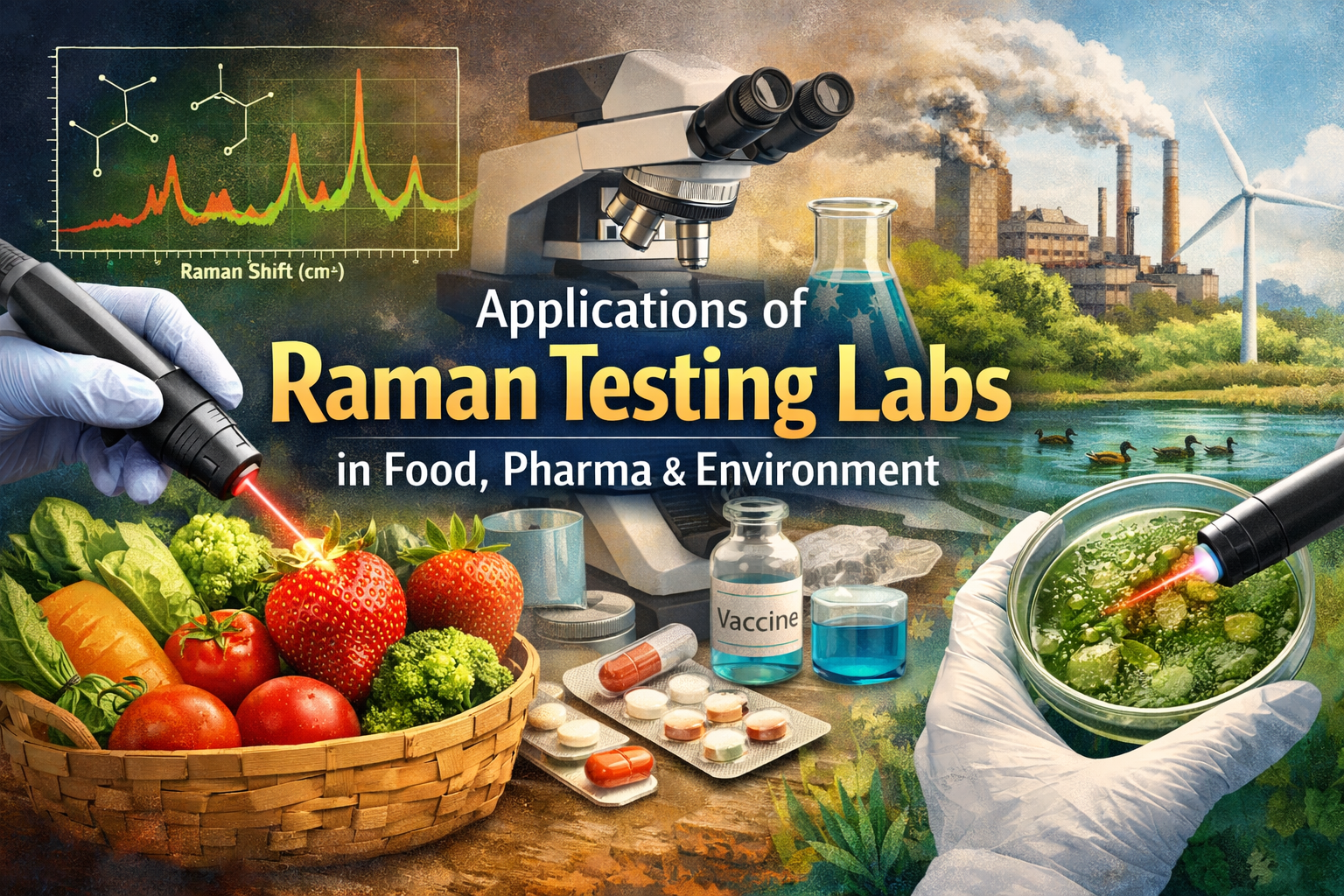
In today’s world, where quality, safety, and regulatory compliance are non-negotiable, advanced analytical technologies play a critical role. Among these, Raman spectroscopy has emerged as one of the most powerful and versatile tools. Raman testing labs leverage this technique to provide rapid, accurate, and non-destructive analysis of materials across multiple industries.
From ensuring food safety to maintaining pharmaceutical quality and monitoring environmental health, Raman testing labs are transforming how industries operate. This detailed guide explores their applications across food, pharmaceutical, and environmental sectors, along with their benefits and future potential.
Understanding Raman Testing Labs
Raman testing labs use Raman spectroscopy, a technique based on the scattering of light, to identify molecular structures and chemical compositions. When a laser interacts with a sample, it produces a unique spectral fingerprint that can be used to identify substances.
Key Features of Raman Testing:
-
Non-destructive testing – Samples remain intact
-
Minimal or no sample preparation
-
High chemical specificity
-
Real-time and rapid analysis
-
Ability to analyze solids, liquids, and gases
These features make Raman testing labs ideal for industries that demand precision, speed, and reliability.
Applications in the Food Industry
Food safety has become a global concern due to increasing cases of adulteration, contamination, and mislabeling. Raman testing labs help ensure that food products meet safety and quality standards.
1. Detection of Food Adulteration
Food adulteration is a major issue, especially in products like milk, spices, oils, and honey. Raman testing labs can:
-
Detect synthetic additives and contaminants
-
Identify dilution or substitution in food products
-
Differentiate between pure and adulterated substances
For example, Raman spectroscopy can quickly identify harmful chemicals in milk or artificial coloring agents in spices.
2. Food Quality Control and Assurance
Maintaining consistent product quality is essential for food manufacturers. Raman testing helps:
-
Analyze chemical composition
-
Detect spoilage or degradation
-
Monitor freshness of products
It enables manufacturers to ensure that products meet defined quality standards before reaching consumers.
3. Authentication and Origin Verification
Food fraud—such as mislabeling origin or substituting premium products—is a growing concern. Raman testing labs help:
-
Verify geographical origin of food items
-
Authenticate premium products like olive oil, honey, and spices
-
Protect brand integrity
4. Nutritional and Ingredient Analysis
Raman spectroscopy provides detailed insights into food composition, including:
-
Protein, fat, and carbohydrate content
-
Presence of additives and preservatives
-
Ingredient distribution in processed food
This helps manufacturers accurately label products and comply with food regulations.
5. Packaging Safety Testing
Food packaging materials can sometimes leach harmful chemicals. Raman testing labs analyze:
-
Plastic and polymer composition
-
Chemical migration risks
-
Safety compliance of packaging materials
Applications in the Pharmaceutical Industry
The pharmaceutical industry relies heavily on precision and compliance. Raman testing labs play a critical role in ensuring drug safety, quality, and effectiveness.
1. Raw Material Identification
Before manufacturing begins, it is essential to verify raw materials. Raman testing labs:
-
Confirm chemical identity of ingredients
-
Detect impurities or contamination
-
Prevent use of counterfeit materials
2. In-Process Quality Control
Raman spectroscopy enables real-time monitoring during drug manufacturing. This helps:
-
Maintain consistency in production
-
Detect deviations early
-
Improve process efficiency
This is especially useful in continuous manufacturing environments.
3. Detection of Counterfeit Drugs
Counterfeit medicines are a global threat. Raman testing labs can:
-
Identify fake drugs without opening packaging
-
Compare chemical fingerprints with genuine products
-
Support regulatory enforcement
4. Polymorph and Crystal Structure Analysis
Different crystalline forms (polymorphs) of a drug can affect:
-
Solubility
-
Stability
-
Bioavailability
Raman spectroscopy accurately identifies these polymorphs, ensuring drug effectiveness.
5. Finished Product Testing
Raman testing is used to analyze tablets, capsules, and injectables:
-
Ensures correct formulation
-
Verifies uniformity of active ingredients
-
Detects defects or inconsistencies
6. Regulatory Compliance and Documentation
Pharmaceutical companies must comply with strict regulations. Raman testing labs help generate:
-
Accurate analytical reports
-
Documentation for audits
-
Data for regulatory submissions
Applications in Environmental Monitoring
Environmental protection is becoming increasingly important as pollution levels rise. Raman testing labs provide fast and reliable tools for environmental analysis.
1. Water Quality Analysis
Water contamination poses serious health risks. Raman testing labs help:
-
Detect chemical pollutants and toxins
-
Identify organic and inorganic contaminants
-
Monitor drinking water safety
It is widely used in testing rivers, lakes, groundwater, and industrial wastewater.
2. Air Pollution Monitoring
Raman spectroscopy can detect:
-
Harmful gases
-
Particulate matter
-
Industrial emissions
This helps industries and governments monitor air quality and take corrective actions.
3. Soil Contamination Testing
Soil pollution affects agriculture and ecosystems. Raman testing labs analyze:
-
Presence of pesticides and fertilizers
-
Heavy metal contamination
-
Industrial waste residues
4. Hazardous Substance Identification
In emergency situations (chemical spills, unknown substances), Raman testing provides:
-
Rapid identification of hazardous materials
-
On-site analysis using portable devices
-
Improved safety for response teams
5. Microplastics Detection
Microplastics are an emerging environmental concern. Raman spectroscopy helps:
-
Identify plastic particles in water and soil
-
Analyze polymer types
-
Support environmental research and regulation
Advantages of Raman Testing Across Industries
Raman testing labs offer several advantages that make them indispensable:
✔ Speed and Efficiency
Provides instant or near real-time results, reducing delays in decision-making.
✔ Non-Destructive Analysis
Samples remain intact, allowing further testing if required.
✔ High Accuracy
Delivers precise chemical identification with minimal error.
✔ Versatility
Applicable to a wide range of materials across industries.
✔ Cost-Effective
Reduces need for chemicals, reagents, and extensive preparation.
Future Trends in Raman Testing Labs
The future of Raman testing labs looks promising with ongoing technological advancements:
1. Portable Raman Devices
Handheld spectrometers are enabling on-site testing in factories, farms, and environmental fields.
2. Integration with AI and Automation
Artificial intelligence is improving data analysis, making results faster and more accurate.
3. Wider Industrial Adoption
More industries are adopting Raman testing for quality assurance and compliance.
4. Advanced Research Applications
Raman spectroscopy is increasingly used in nanotechnology, biotechnology, and material science.
Conclusion
Raman testing labs are playing a transformative role across the food, pharmaceutical, and environmental sectors. Their ability to provide fast, accurate, and non-destructive analysis makes them an essential tool for ensuring safety, quality, and compliance.
From detecting food adulteration and verifying pharmaceuticals to monitoring environmental pollution, Raman testing labs are helping industries meet modern challenges with confidence. As technology continues to evolve, their importance will only grow—making them a cornerstone of advanced analytical science.