English
 Arabic
 French
 Spanish
 Portuguese
 Deutsch
 Turkish
 Dutch
Dutch
 Italiano
 Russian
 Romaian
 Portuguese (Brazil)
 Greek
Greek
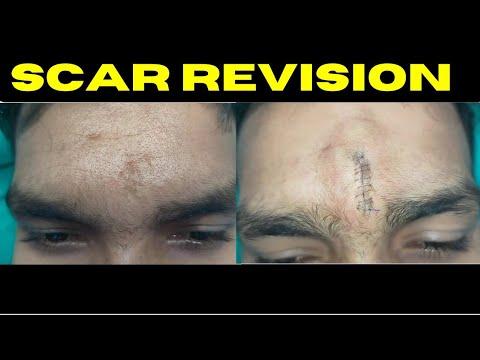
Scalp Scar Revision: Surgical Options for Hair Restoration Compatibility
The clinical management of alopecia resulting from trauma, surgery, or burns requires a specialized reconstructive approach, particularly when seeking Surgical Scar Revision Riyadh. The scalp is a unique anatomical site characterized by high tension, a rich vascular supply, and the presence of terminal hair follicles. Traditional scar revision techniques often fall short on the scalp because a "flat" scar that is devoid of hair remains highly visible against the surrounding dense foliage. To achieve a truly inconspicuous result, the surgical strategy must focus on "trichophytic" closure techniques and tension-reduction maneuvers that preserve the viability of the surrounding hair follicles, ensuring that the final result is compatible with future hair transplantation or natural hair growth.
The Challenge of Scalp Tension and Scar Widening
One of the most significant hurdles in scalp reconstruction is the "galea aponeurotica," a tough, inelastic layer of fibrous tissue beneath the skin. This layer limits the scalp's natural stretch, often causing surgical incisions to widen into broad, shiny "bald" patches over time.
-
Tension-Induced Alopecia: When a scalp wound is closed under excessive pressure, the blood supply to the hair follicles is compromised. This "pressure necrosis" leads to a permanent loss of hair along the edges of the scar.
-
The Galeal Release: To counteract this, surgeons perform "galeal scoring"—making a series of shallow, parallel incisions in the underside of the galea. This allows the scalp to "expand" slightly, enabling a tension-free closure that protects the delicate hair follicles.
Trichophytic Closure: The Key to Invisible Scars
The "trichophytic" closure is perhaps the most important innovation in Surgical Scar Revision in Riyadh for the scalp. This technique is designed to allow hair to grow directly through the scar tissue, effectively camouflaging the line.
-
Ledge Preparation: During the excision of the old scar, the surgeon trims the upper edge of one side of the incision at a 45-degree angle. This removes the very top layer of the skin while leaving the deep "bulge" of the hair follicles intact.
-
Overlapping the Edge: The opposite side of the incision is then pulled over this beveled "ledge."
-
Trans-Scat Growth: As the wound heals, the hair follicles trapped beneath the overlapping skin begin to grow. Because they are aimed upward, the hairs emerge directly through the newly formed scar. Instead of a bare gap, the result is a thin line with hair sprouting from it, making the revision nearly impossible to detect even with short hair.
Tissue Expansion for Large Scalp Defects
When a scalp scar is too wide to be closed with simple excision—such as after a major burn or a large tumor removal—surgeons utilize tissue expansion. This is the gold standard for restoring hair-bearing skin to a bald area.
-
Growing Hair-Bearing Skin: A silicone expander is placed under the healthy, hair-bearing part of the scalp. Over several months, it is inflated with saline, stretching the scalp and the hair follicles within it.
-
The "Serial" Advantage: Once the expansion is complete, the bald scar is removed, and the "expanded" hair-bearing scalp is rotated to cover the defect. While the hair density may decrease slightly, the result is a full head of hair without the need for a hairpiece.
Compatibility with Hair Transplantation (FUE/FUT)
For many individuals, Surgical Scar Revision in Riyadh is the first step in a multi-stage hair restoration journey. A surgical revision "prepares the soil" for future Follicular Unit Extraction (FUE).
-
Softening the Foundation: Thick, fibrotic scar tissue has a poor blood supply, making it difficult for transplanted hair grafts to "take." A surgical revision replaces this hard tissue with a softer, more vascularized dermal layer.
-
Scar "Stippling": If a thin scar remains after revision, a surgeon may use "micro-punch" grafting. Small 1mm punches of hair are taken from the back of the head and placed directly into the revised scar.
-
Scalp Micropigmentation (SMP) Synergy: In cases where hair density remains a concern, surgical revision provides a flat, level surface for medical-grade tattooing. SMP can "fill in" the remaining shadows, creating the illusion of hair follicles within the revised line.
Post-Surgical Maturation in an Arid Climate
The recovery phase on the scalp is influenced by the region's environmental factors. The scalp's high sebaceous (oil) production can sometimes lead to "folliculitis" (ingrown hairs) during the healing phase of a trichophytic closure.
-
Antiseptic Maintenance: Patients are placed on a strict cleaning regimen to keep the hair follicles clear of debris and crusting.
-
Silicone Stabilization: Although difficult to apply in hair-bearing areas, specialized silicone gels are used to keep the scar tissue hydrated. This prevents the "itching" that often leads to scratching and secondary trauma to the new incision.
-
UV Protection: Because the scalp is often the most sun-exposed part of the body, physical protection (hats) is mandatory for the first six months to prevent the scar from darkening.
Summary of the Scalp Restoration Strategy
Scalp scar revision is a high-stakes procedure that requires a balance between mechanical tension management and biological follicle preservation. By utilizing galeal releases to reduce stretch, trichophytic techniques to allow hair growth through the scar, and tissue expansion for larger defects, surgeons can restore the natural continuity of the scalp. The goal is to move from a visible, bald "void" to a harmonious, hair-bearing surface that restores both the patient's appearance and their ability to style their hair with confidence. Through these surgical options, the scalp becomes a viable canvas for continued hair restoration and a return to a natural aesthetic.