English
 Arabic
 French
 Spanish
 Portuguese
 Deutsch
 Turkish
 Dutch
Dutch
 Italiano
 Russian
 Romaian
 Portuguese (Brazil)
 Greek
Greek
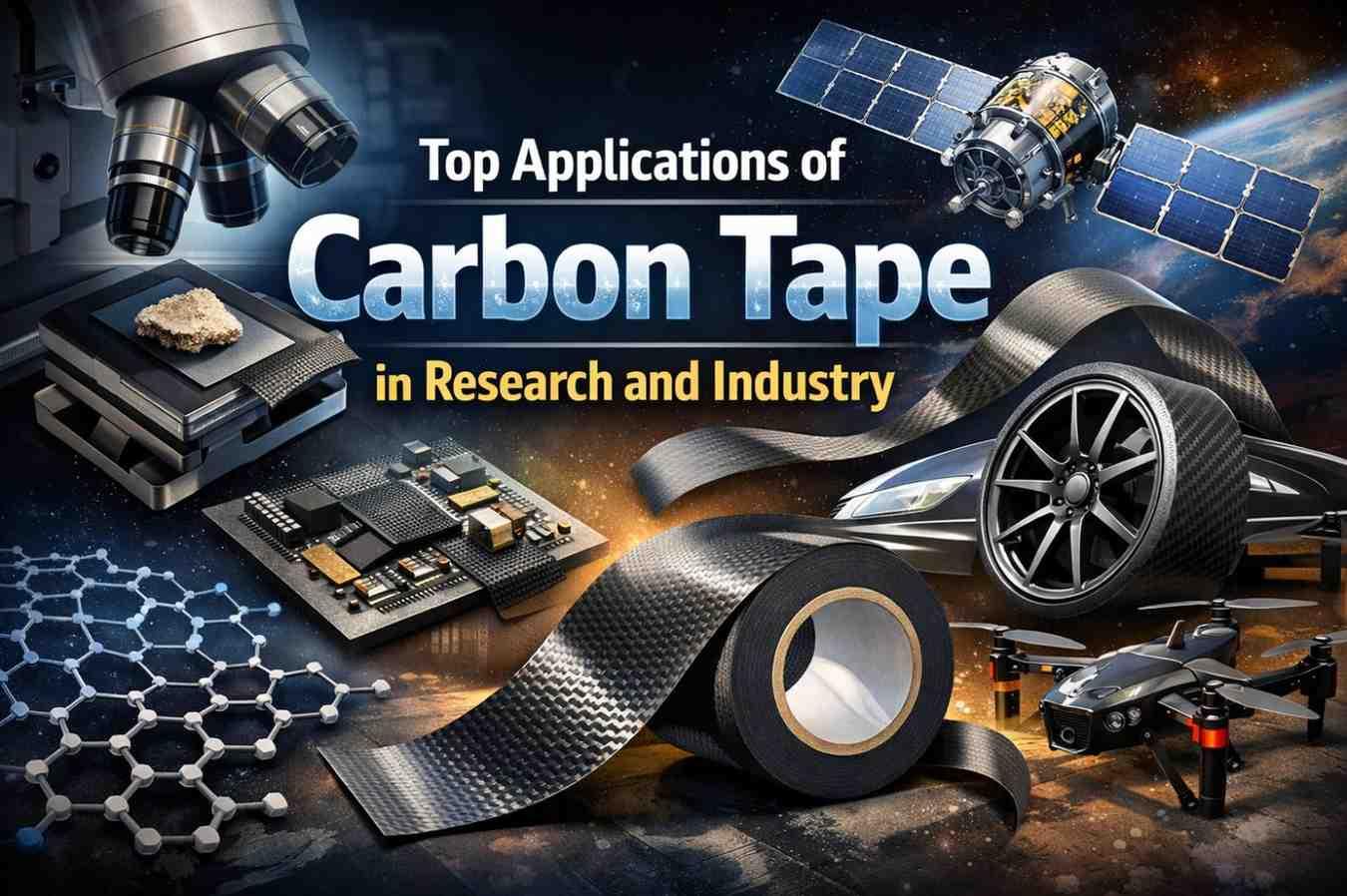
Carbon tape is a small but powerful consumable that plays a crucial role in modern laboratories and industrial environments. Its combination of electrical conductivity, strong adhesion, low contamination, and ease of handling makes it indispensable for a wide range of scientific and technical applications.
From high-resolution imaging to advanced material testing, carbon tape ensures accuracy, stability, and reliability in processes where even minor errors can lead to significant consequences. In this detailed blog, we will explore the top applications of carbon tape in research and industry, along with its importance in each domain.
What is Carbon Tape?
Carbon tape is a double-sided adhesive tape coated with conductive carbon material. It is specifically designed to provide both mechanical support (adhesion) and electrical conductivity, making it ideal for applications involving sensitive instruments and analytical techniques.
It is commonly available in:
-
Rolls
-
Pre-cut tabs
-
Different thicknesses and adhesive strengths
1. Sample Mounting in Electron Microscopy (SEM)
One of the most critical uses of carbon tape is in Scanning Electron Microscopy (SEM).
Why Carbon Tape is Essential in SEM:
In SEM, a focused electron beam scans the surface of a sample to produce high-resolution images. However, non-conductive samples tend to accumulate electrical charge, which can distort images and reduce clarity.
Carbon tape solves this problem by:
-
Providing a conductive pathway to dissipate excess electrons
-
Firmly holding the sample in place during imaging
-
Reducing vibration and movement
Impact:
-
Prevents charging artifacts (bright spots, streaks)
-
Enhances image resolution and contrast
-
Enables accurate surface morphology analysis
Without carbon tape, SEM imaging of materials like polymers, ceramics, or biological samples would be extremely challenging.
2. Energy Dispersive Spectroscopy (EDS) Analysis
Carbon tape is widely used in conjunction with Energy Dispersive Spectroscopy (EDS), a technique used to determine the elemental composition of materials.
Why Carbon Tape is Preferred:
-
Carbon has a low atomic number, which minimizes interference in X-ray signals
-
Produces low background noise during analysis
-
Does not significantly affect elemental peaks
Applications in EDS:
-
Identifying unknown materials
-
Detecting impurities or contaminants
-
Supporting failure analysis in industrial components
Example:
In metallurgy, carbon tape allows accurate detection of elements like iron, nickel, and chromium without introducing significant spectral interference.
3. Material Science and Engineering Research
Material science heavily relies on precise sample preparation, and carbon tape plays a key role in this process.
Applications:
-
Mounting metals, ceramics, polymers, and composites
-
Studying surface coatings and thin films
-
Analyzing fractures and microstructures
Why It’s Important:
-
Holds irregular or brittle samples securely
-
Prevents sample displacement during testing
-
Maintains structural integrity
Real-World Use Case:
Researchers studying nanocomposites or advanced coatings depend on carbon tape to ensure that samples remain stable under high magnification and electron exposure.
4. Electronics and Semiconductor Industry
In the electronics sector, carbon tape is essential for handling and analyzing delicate components.
Key Applications:
-
Mounting microchips and circuit components for inspection
-
Supporting failure analysis of electronic devices
-
Preventing electrostatic discharge (ESD)
Importance:
Electronic components are highly sensitive to static electricity. Carbon tape provides:
-
A conductive path to neutralize charges
-
Safe handling during testing and inspection
Example:
During PCB (Printed Circuit Board) analysis, carbon tape ensures components remain stable and protected from static damage.
5. Forensic Science and Failure Analysis
Carbon tape is widely used in forensic laboratories and industrial investigations.
Applications:
-
Collecting microscopic evidence (dust, fibers, particles)
-
Mounting samples for SEM examination
-
Investigating material defects and fractures
Advantages:
-
Non-destructive sampling
-
Minimal contamination
-
High precision in analysis
Example:
In a forensic lab, carbon tape can be used to lift trace evidence from surfaces and analyze it under SEM to identify its origin.
6. Nanotechnology and Advanced Research
In nanotechnology, where materials are studied at the atomic or molecular level, carbon tape becomes even more critical.
Uses:
-
Mounting nanoparticles and nanostructures
-
Supporting high-resolution imaging
-
Stabilizing ultra-small samples
Why It Matters:
At the nanoscale, even slight movement or contamination can ruin results. Carbon tape ensures:
-
Maximum stability
-
Minimal interference
-
Accurate imaging and measurement
7. Industrial Quality Control and Manufacturing
Carbon tape is extensively used in industries for quality assurance and inspection.
Applications:
-
Surface defect analysis
-
Coating and plating inspection
-
Contamination detection
Industries Using Carbon Tape:
-
Automotive
-
Aerospace
-
Metallurgy
-
Pharmaceuticals
Benefits:
-
Quick and reliable sample preparation
-
Consistent results across multiple tests
-
Improved production quality
8. Geological and Environmental Analysis
Carbon tape is also used in geology and environmental science.
Applications:
-
Analyzing soil and mineral samples
-
Studying airborne particles and pollutants
-
Examining rock microstructures
Advantages:
-
Strong adhesion for uneven samples
-
Accurate imaging of natural materials
-
Reliable compositional analysis
9. Battery and Energy Research
With the rapid growth of renewable energy, carbon tape is playing a role in battery development and energy storage research.
Applications:
-
Studying electrode materials
-
Analyzing degradation mechanisms
-
Supporting lithium-ion battery research
Importance:
It helps researchers understand how materials behave under different conditions, leading to better and more efficient energy solutions.
10. Fast and Efficient Sample Preparation
One of the biggest advantages of carbon tape is its simplicity.
Why It Stands Out:
-
No curing or drying time required
-
Easy to cut and apply
-
Compatible with various sample types
Impact on Workflow:
-
Saves time in high-throughput labs
-
Reduces preparation errors
-
Increases overall efficiency
Key Benefits of Carbon Tape
-
Excellent electrical conductivity
-
Strong and reliable adhesion
-
Minimal analytical interference
-
Easy handling and application
-
Wide compatibility across industries
Limitations to Consider
While carbon tape is highly versatile, it does have some limitations:
-
May lose adhesion under extreme temperatures
-
Not suitable for very heavy samples
-
Requires proper storage to maintain effectiveness
Conclusion
Carbon tape is far more than just an adhesivec - it is a critical tool that enables precision, accuracy, and efficiency across a wide range of scientific and industrial applications.
From electron microscopy and nanotechnology to electronics, forensics, and energy research, carbon tape supports processes where stability and conductivity are essential. Its ability to simplify sample preparation while maintaining analytical integrity makes it a must-have in modern labs and industries.
As research continues to evolve and technologies become more advanced, the importance of carbon tape will only grow, reinforcing its role as a foundational material in scientific and industrial innovation.