English
 Arabic
 French
 Spanish
 Portuguese
 Deutsch
 Turkish
 Dutch
Dutch
 Italiano
 Russian
 Romaian
 Portuguese (Brazil)
 Greek
Greek
Coronal vs. Pretrichial Lifts: Choosing Your Ideal Technique
The evolution of upper facial rejuvenation has moved toward a high degree of customization, where the surgical approach is dictated by the specific anatomical needs of the patient rather than a "one-size-fits-all" mentality. For individuals considering a Forehead lift Riyadh, the choice between a coronal (traditional) lift and a pretrichial (hairline) lift is a pivotal decision that impacts not only the smoothness of the brow but also the overall proportions and framing of the face. While both procedures offer powerful structural corrections for deep-seated wrinkles and significant brow ptosis, they differ fundamentally in how they interact with the hairline. Choosing the ideal technique requires a meticulous evaluation of forehead height, hair density, and the desired final aesthetic balance of the facial thirds.
The Coronal Lift: The Classic Path to Comprehensive Rejuvenation
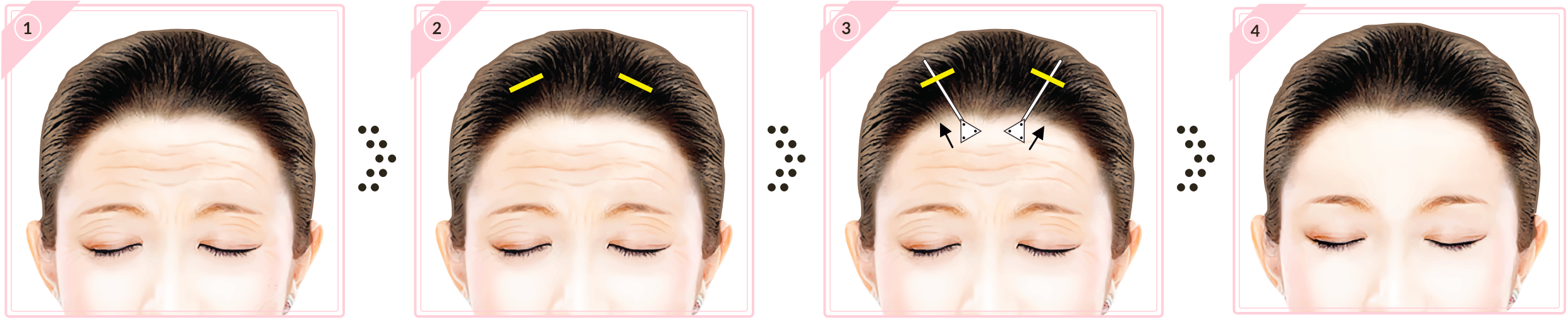
The coronal lift is the original gold standard of forehead surgery, known for its ability to provide an extensive and uniform elevation across the entire upper face. The incision for a coronal lift is made several centimeters behind the hairline, running from ear to ear across the top of the scalp.
-
Mechanism and Visual Access: Because the incision is placed deep within the hair-bearing scalp, the surgeon has unparalleled access to the underlying musculature. This allows for the precise removal of excess skin and the modification of the muscles that cause deep horizontal furrows and vertical "11" lines.
-
The "Lifting" Effect: As the skin is redraped and the excess is removed, the forehead is smoothed and the brows are elevated. However, because the skin is pulled upward and backward, the hairline naturally migrates higher.
-
Ideal Candidate: This technique is often "best" for patients with a naturally low forehead or those with thick hair who do not mind a slight increase in the vertical height of their forehead. It is a robust solution for correcting severe sagging where a significant amount of tissue must be excised to achieve a smooth result.
The Pretrichial Lift: A Solution for the High Forehead
In contrast, the pretrichial lift—often referred to as a "hairline-lowering" lift—is specifically designed for patients who are concerned that their forehead is already too high or who wish to avoid any further recession of the hairline. The incision for this technique is made right at the very front edge of the hair-bearing scalp.
-
Proportional Correction: The primary advantage of the pretrichial lift is its ability to shorten the forehead. By removing a strip of skin from the non-hair-bearing forehead rather than the scalp, the surgeon can physically pull the hairline forward and downward. This is a transformative tool for restoring the "Rule of Thirds," where the forehead, mid-face, and lower face are brought into a more harmonious 1:1:1 balance.
-
Scar Camouflage: Modern pretrichial techniques utilize a "trichophytic" incision, where the skin is cut at an angle that allows hair follicles to grow through the resulting scar. As the hair matures, the transition between the forehead and the scalp becomes virtually seamless.
-
Ideal Candidate: This is the preferred technique for patients with high foreheads, thin hair at the frontal hairline, or those who simply want a rejuvenated brow without shifting their hair backward.
Comparing Hairline Dynamics and Facial Framing
The most significant differentiator between these two procedures is the final position of the hairline. A patient’s hairline is the "frame" for their face, and shifting it even by a few millimeters can profoundly alter their appearance.
| Feature | Coronal Lift | Pretrichial Lift |
| Incision Location | 3–5 cm behind the hairline | At the edge of the hairline |
| Forehead Height | Increases (Hairline moves back) | Decreases (Hairline moves forward) |
| Visibility of Scar | Hidden deep in the hair | At the hairline (camouflaged by hair) |
| Nerve Impact | Slightly higher risk of scalp numbness | Lower risk of posterior scalp numbness |
| Primary Goal | Max lifting and smoothing | Rejuvenation + Proportional correction |
For many in the Riyadh aesthetic market, the pretrichial lift is viewed as a highly sophisticated "two-in-one" procedure. It doesn't just address the signs of aging; it actively improves the structural framing of the face, making it a favorite for those seeking to refine their overall facial geometry.
Precision Fixation and Long-Term Stability
Regardless of the incision style chosen, the success of a modern forehead lift in 2026 relies on deep-plane fixation. In both coronal and pretrichial approaches, the surgeon secures the underlying tissues to the bone or deep fascia. This ensures that the lift is supported by the internal architecture of the face rather than just the skin.
This structural support is what provides the longevity associated with these "open" techniques. While endoscopic lifts are popular for their minimal downtime, coronal and pretrichial lifts are often favored by patients with advanced tissue laxity because they allow for the physical removal of redundant skin. This results in a "crispness" to the brow and a smoothness to the forehead that can last for 15 years or more, providing a permanent solution to the gravitational changes of aging.
Navigating the Recovery Process
The recovery timelines for these two procedures are relatively similar, though they involve different considerations. Because both techniques involve a continuous incision, patients can expect some swelling and bruising around the forehead and eyes, which typically peaks within the first 72 hours.
-
Coronal Recovery: Patients may experience temporary numbness at the top of the scalp, which usually resolves over several months as the sensory nerves regenerate.
-
Pretrichial Recovery: Focus is placed on meticulous wound care at the hairline to ensure the trichophytic effect is maximized. Patients often wear their hair forward during the first two weeks to camouflage the healing line.
Most patients in Riyadh find they can return to their professional and social obligations within 14 to 21 days. By the three-month mark, the incisions have faded significantly, and the new facial proportions are fully realized. By weighing the impact on the hairline against the need for structural lifting, patients can select the technique that will provide the most natural, balanced, and elegantly refreshed upper face.