English
 Arabic
 French
 Spanish
 Portuguese
 Deutsch
 Turkish
 Dutch
Dutch
 Italiano
 Russian
 Romaian
 Portuguese (Brazil)
 Greek
Greek
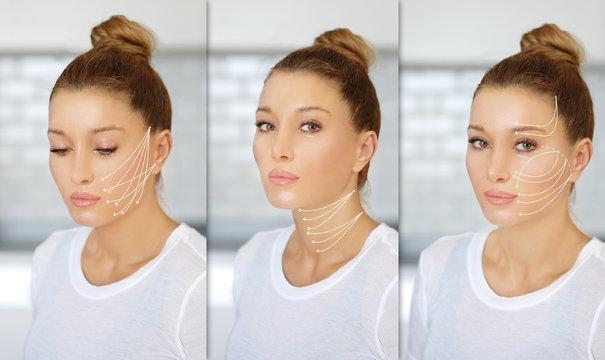
How Vector Facelifts Target Sagging Skin and Early Jowls
The onset of facial aging often manifests as a subtle shift in the lower third of the face, where the crisp definition of the jawline begins to yield to the effects of gravity, making the Vector Facelift in Riyadh a targeted solution for those noticing the first signs of tissue descent. Early jowls and mid-face sagging are not merely skin-deep issues; they are the result of the downward migration of fat pads and the weakening of the retaining ligaments that once held facial structures in a youthful "V" position. A vector-based approach treats these concerns by re-establishing the structural tension required to pull these tissues back into place. By focusing on the mechanics of the lift rather than just the volume of the filler, this technique effectively "anchors" sagging skin, providing a non-surgical correction that restores the sharp, elegant contours of the lower face.
The Anatomy of the Jowl: Why Tissue Drops
To understand how a vector lift works, one must first understand the "jowl." Jowling occurs when the skin loses its elastic "snap" and the malar fat pads in the cheeks slide downward. This excess tissue accumulates along the mandibular line (the jawbone), creating a "heavy" look.
In traditional treatments, practitioners might have simply filled the area in front of the jowl to disguise it. However, the vector facelift focuses on repositioning rather than camouflaging. It identifies the "vector of descent"—the diagonal path the tissue took as it fell—and creates a corrective "vector of ascent" to reverse it.
Mechanics of the Target: The Three-Point Anchor
Targeting early jowls requires a strategic approach that pulls the skin away from the chin and back toward the ear. The vector technique typically utilizes three primary anchor points to achieve this:
-
The Pre-Auricular Anchor: Located just in front of the ear, this is the most critical point for jowl correction. By placing lifting material here, the practitioner creates a "pull" that tensions the skin along the entire jawline.
-
The Zygomatic Arch: Lifting from the cheekbones helps to "hoist" the mid-face. As the cheeks are elevated, they take some of the weight off the lower face, indirectly reducing the appearance of sagging skin around the mouth.
-
The Mandibular Angle: Placing a vector at the corner of the jaw helps to define the back of the face, which stretches the skin horizontally and eliminates the "bulge" of the jowl.
Bio-Stimulation vs. Mechanical Pull
While the immediate correction of sagging skin is mechanical (the filler or thread physically holds the skin up), the long-term targeting of jowls is biological.
-
Collagen Scaffolding: Many vector treatments use bio-stimulatory agents that trigger the production of new Type I collagen.
-
The "Shrink-Wrap" Effect: As this new collagen forms along the mapped vectors, it creates a natural tightening effect. This acts like an internal "shrink-wrap" for the jawline, ensuring that the skin remains taut and resistant to further gravitational pull even after the initial treatment begins to settle.
Why Early Intervention is Key
The vector facelift is particularly effective for "early" jowls because it works best when the skin still possesses a degree of natural resilience.
Professional Note: By addressing sagging skin at its earliest stages, patients can effectively "prevent" the need for more invasive surgical procedures later in life. It maintains the "V-shape" of the face proactively, ensuring the mandibular line remains clear and unobstructed.
Expected Outcomes for the Lower Face
When targeting the lower face with a vector lift, patients can expect a transformation that emphasizes clarity and definition:
-
Reduced Marionette Lines: The lines running from the corners of the mouth to the chin are softened as the skin is pulled back toward the ears.
-
Mandibular Definition: The jawbone becomes visible again, creating a clear separation between the face and the neck.
-
Slimmer Profile: By removing the "heaviness" at the bottom of the face, the overall profile appears more athletic and youthful.
Conclusion
Targeting sagging skin and early jowls requires more than just filling a wrinkle; it requires an understanding of facial physics. The vector facelift provides this by using directional tension to return tissue to its rightful place. It offers a sophisticated, minimally invasive way to "reset" the jawline, providing individuals with a rejuvenated look that feels as natural as it looks. By focusing on the underlying causes of facial descent, the vector technique ensures that the fight against gravity is won with precision and elegance.