English
 Arabic
 French
 Spanish
 Portuguese
 Deutsch
 Turkish
 Dutch
Dutch
 Italiano
 Russian
 Romaian
 Portuguese (Brazil)
 Greek
Greek
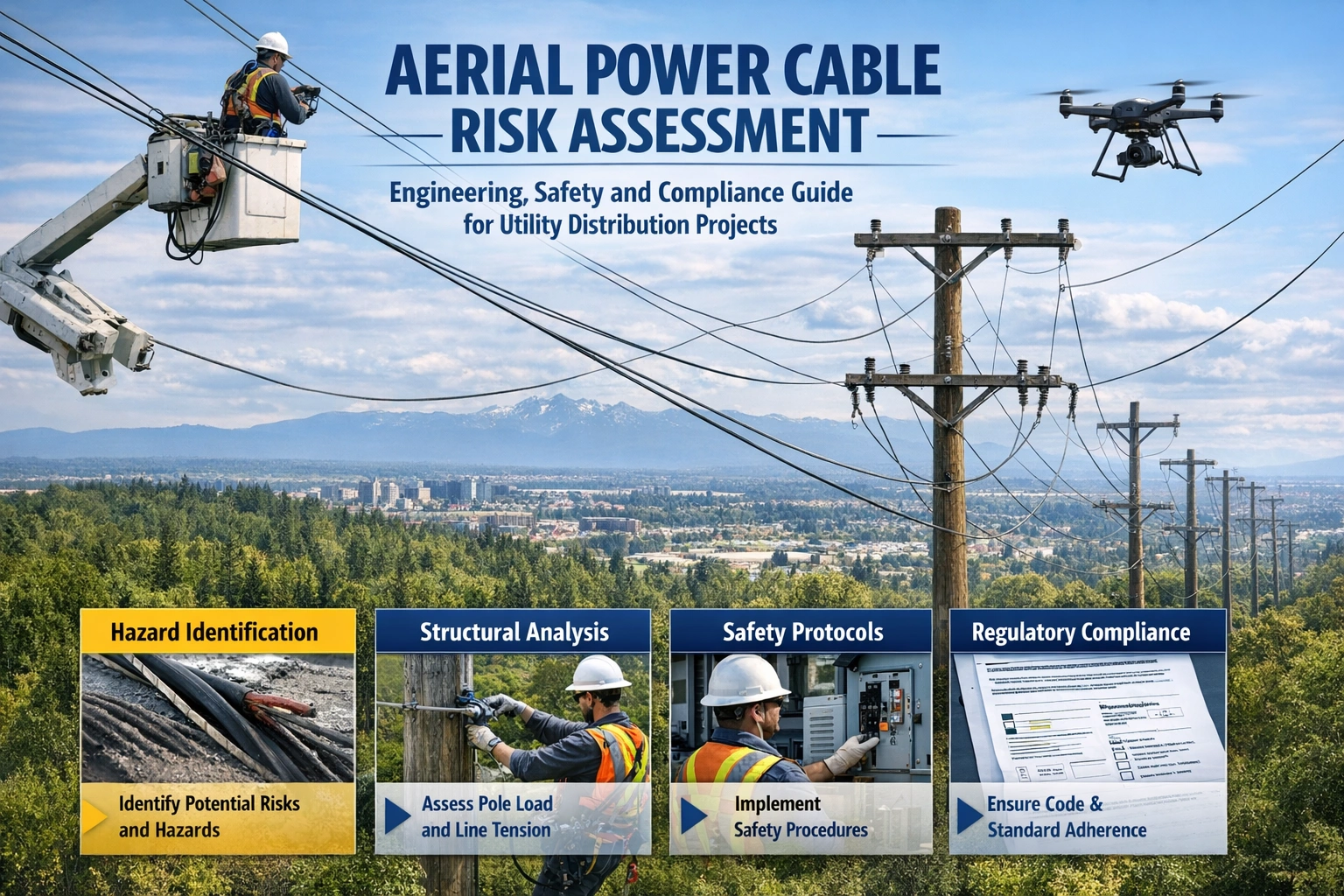
In today’s fast-evolving power transmission and distribution sector, aerial power cable systems play a critical role in delivering safe, efficient, and cost-effective electricity across urban, rural, and industrial networks. For utilities, EPC contractors, engineers, and procurement teams, selecting the right overhead cable solution directly impacts grid reliability, installation speed, maintenance costs, and long-term operational performance.
As global energy demand continues to rise, modern infrastructure projects require cable systems that can withstand harsh environmental conditions, reduce power loss, and support scalable network expansion. This is where HNBF Power stands out as a trusted global manufacturer of overhead conductors and power cable solutions, delivering engineered products for demanding utility applications.
What Is an Aerial Power Cable?
An aerial power cable refers to an insulated or bare conductor cable system installed above ground on poles, towers, or other support structures for electrical power distribution and transmission. These cable systems are widely used because they offer:
- Faster installation compared to underground systems
- Lower infrastructure and civil engineering costs
- Easier inspection and maintenance
- Better suitability for remote and difficult terrain
- Flexible upgrades for expanding distribution lines
Common aerial cable systems include ABC cable (Aerial Bundled Cable), AAC, AAAC, and ACSR conductors, each designed for different voltage classes and mechanical load requirements.
For utilities and project engineers, the main challenge is choosing the right conductor type based on span length, environmental stress, corrosion exposure, and current-carrying capacity.
Why Aerial Power Cables Are Preferred in Utility Distribution
Cost-Effective Network Expansion
One of the biggest pain points for utility buyers is balancing budget control with network reliability. Underground cable systems often require trenching, ducting, land restoration, and complex permitting, significantly increasing project costs.
Aerial cable systems eliminate much of this expense. With reduced civil works and faster deployment, they become the preferred option for:
- Rural electrification projects
- Municipal distribution upgrades
- Temporary power systems
- Industrial facility expansions
- Renewable energy grid connections
HNBF Power helps project teams reduce total installed cost by offering optimized conductor designs that combine mechanical strength with electrical efficiency.
Improved Safety in Dense Urban Areas
In crowded city environments, exposed bare conductors can create safety risks due to accidental contact, tree interference, or storm-related faults. This is why aerial bundled cable solutions are increasingly adopted.
Insulated aerial cable systems help minimize:
- Short-circuit risks
- Power theft
- Vegetation-related outages
- Maintenance interruptions
- Public safety concerns
For municipal utilities and developers, this provides a practical solution for safer low-voltage and medium-voltage distribution systems.
Key Types of Aerial Power Cable for Utility Projects
AAC – All Aluminum Conductor
AAC is commonly used for short-span distribution networks where conductivity is the primary requirement. Its lightweight design and strong conductivity make it ideal for urban overhead lines.
Best for:
- Short-distance distribution
- Urban feeders
- Low mechanical stress environments
AAAC – All Aluminum Alloy Conductor
AAAC provides improved tensile strength and corrosion resistance compared to AAC. It is ideal for coastal zones, industrial pollution environments, and long-life infrastructure.
Best for:
- Coastal utility grids
- Corrosion-prone regions
- Long-span distribution
ACSR – Aluminum Conductor Steel Reinforced
For projects requiring superior mechanical performance, ACSR remains the industry standard. The steel core improves tensile strength, making it ideal for long spans and transmission corridors.
Best for:
- High mechanical load zones
- River crossings
- Mountain transmission routes
- High-voltage overhead lines
ABC – Aerial Bundled Cable
ABC cable is one of the most popular aerial distribution solutions due to its insulated bundled design. It is especially effective in residential and commercial distribution systems.
Best for:
- Low-voltage service lines
- Urban street networks
- High-theft areas
- Tree-dense environments
HNBF Power manufactures all these aerial cable variants with strict quality control for global utility standards.
How to Choose the Right Aerial Power Cable
Evaluate Electrical Load Requirements
The first engineering consideration is ampacity. Procurement teams must ensure the cable supports current demand while minimizing transmission loss.
HNBF Power supports customized conductor sizing to match:
- Voltage class
- Load growth expectations
- Peak demand cycles
- Thermal operating limits
Assess Environmental Conditions
Environmental durability is a major factor in cable lifecycle performance. Buyers should consider:
- UV exposure
- High wind load
- Ice accumulation
- Coastal corrosion
- Industrial chemical exposure
Selecting the wrong conductor material can lead to early failure, frequent outages, and higher replacement costs.
Consider Installation and Span Design
Mechanical loading, sag performance, and tower spacing all affect conductor choice. For long-span projects, ACSR or AAAC often provides better performance than AAC.
HNBF Power works closely with EPC contractors and utility engineers to match conductor construction with real-world installation conditions.
Why Engineers and Buyers Choose HNBF Power
Choosing the right cable supplier is just as important as selecting the right conductor. Procurement teams need consistent quality, international compliance, and flexible production support.
HNBF Power delivers value through:
Global Manufacturing Expertise
As a professional manufacturer of overhead conductors and power cables, HNBF Power supports utility projects worldwide with scalable production capacity.
Customized Engineering Support
Every grid project has unique load, terrain, and regulatory requirements. HNBF Power provides customized aerial cable solutions tailored to project specifications.
Reliable Quality Assurance
All cable products undergo strict testing for:
- Tensile strength
- Conductor resistance
- Insulation performance
- Weather durability
- Dimensional accuracy
This helps utilities reduce procurement risk and improve long-term asset performance.
Frequently Asked Questions
What is the main advantage of aerial power cable?
The main advantage is lower installation cost combined with easier maintenance and faster deployment compared to underground systems.
Which aerial cable is best for long spans?
ACSR is typically the best choice for long-span overhead transmission due to its steel-reinforced strength.
Is aerial bundled cable safer than bare conductors?
Yes. ABC cable offers better insulation protection, reduced fault risk, and improved public safety in urban areas.
Can HNBF Power customize aerial cable specifications?
Yes. HNBF Power provides customized conductor designs based on voltage, load, span, and environmental requirements.
Which conductor is best for coastal environments?
AAAC is highly recommended for coastal and corrosive environments because of its superior alloy corrosion resistance.
Build Stronger Utility Networks with HNBF Power
The right aerial power cable solution improves grid reliability, lowers lifecycle costs, and supports efficient power distribution across every terrain. Whether your project requires AAC, AAAC, ACSR, or ABC cable, choosing an experienced manufacturing partner ensures technical success from specification to installation.
Contact HNBF Power today for customized aerial power cable solutions designed for utilities, EPC contractors, and modern grid infrastructure projects worldwide.