 English
 Arabic
 French
 Spanish
 Portuguese
 Deutsch
 Turkish
 Dutch
Dutch
 Italiano
 Russian
 Romaian
 Portuguese (Brazil)
 Greek
Greek
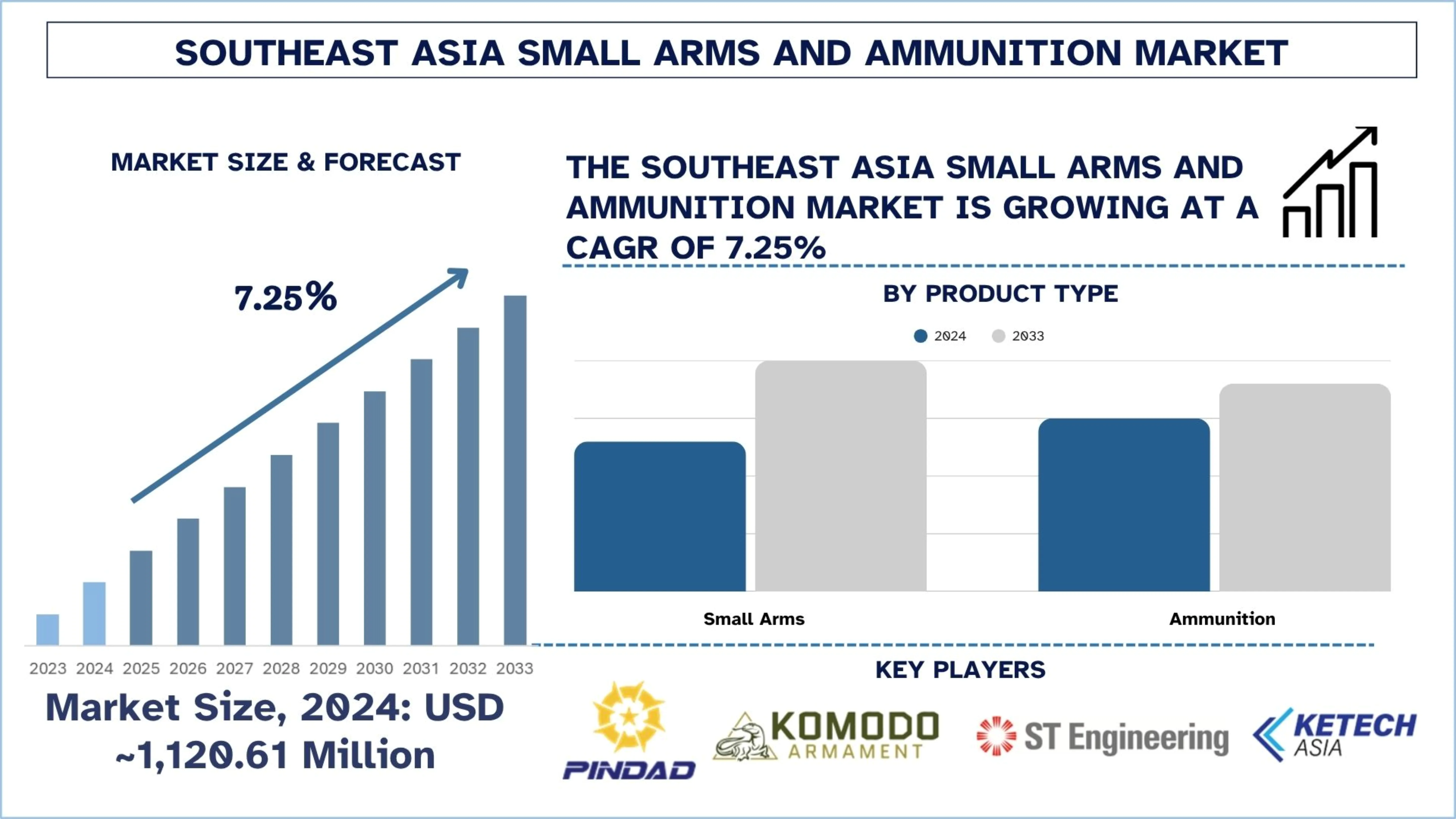
The Southeast Asia Small Arms and Ammunition Market was valued at ~USD 1,120.61 million in 2024 and is expected to grow at a strong CAGR of approximately 7.25% during the forecast period (2025-2033F),
The Southeast Asia small arms and ammunition market is driven by rising defense expenditure, infantry upgrades, and repeat ammunition purchases by military and internal security agencies, with long-term demand.
Regionally, Indonesia has had the largest market share, owing to its development of a domestic manufacturing base and policies of self-reliance in defense, whereas, in terms of the rate of market growth, the Philippines is the rapidly developing market, owing to the active modernization of armed forces and the growth of tactical procurement.
Segment-wise, ammunition remains the largest revenue generator due to repeat replacements, but 5.56 mm caliber and modern rifle platforms are showing even higher growth rates as procurement preferences have shifted toward lightweight, NATO-compatible weaponry.
The competitive level is rising as regional manufacturers enhance their production capacity, fine-tune caliber standardization, and improve supply dependability due to technological improvements, as defense procurement is turning to suppliers capable of meeting its long-term quality and delivery demands.
Through licensed model production, defense industry collaboration, and investments in localized ammunition assembly, ballistic testing capacity, and high-tech machining, the strategic growth is helping strengthen the region's supply base and increase its export capacity in the future.
The major growth factor is increased regional security spending associated with border patrol, maritime conflicts, domestic insurgency containment, and defense preparedness initiatives. The process of military modernization in the leading countries of Southeast Asia is gaining momentum, with the replacement of old-fashioned rifles and a rising need for recurring ammunition reserves. Simultaneously, the growth of law enforcement, the use of special tactical units, and homeland security preparedness are creating relentless procurement pressure, and the domestic defense industrial policy is promoting partial self-sufficiency in the manufacture of weaponry and cartridges.
For example, on February 8, 2026, Malaysia’s first high-automation ammunition manufacturing facility owned by Ketech Asia Sdn. Bhd. (Ketech Asia) In Kuala Lipis, Pahang, it operated at full capacity. Defence Security Asia, Ketech Asia Business Development Manager, announced that the facility is currently producing up to 130 million rounds of 9mm and 5.56mm ammunition annually for the domestic market.
Access sample report (including graphs, charts, and figures): https://univdatos.com/reports/southeast-asia-small-arms-and-ammunition-market?popup=report-enquiry
Driver: Rising Defense Budget Allocation
The expansion of defense budgetary allocations is a key driver in the Southeast Asia small arms and ammunition market, with governments investing heavily in military spending to enhance national and border security and military preparedness. Also, the increased defense expenditure directly influences the procurement of rifles, handguns, machine guns, and ammunition necessary for training and operational deployment. In addition, a larger share of these budgets is being channeled into replacing old infantry weapons and building a strategic reserve of ammunition. This continuous increase in budgets across various Southeast Asian countries promotes long-term procurement agreements and localized production projects. Moreover, this financial assistance provides manufacturers with stable visibility into demand and supports overall market growth.
Segments that transform the industry
Based on product type, the market is segmented into small arms (pistols, revolvers, rifles, shotguns, light machine guns, submachine guns, others) and ammunition (rimfire, centerfire). Among these, the ammunition market held a dominant share of the market in 2024. This segment drives recurring demand for ammunition purchases due to training, operational deployments, reserve stocking, and replacement demands. The continuous consumption of ammunition, unlike that of weapon platforms, is urging manufacturers to increase production capacity, enhance supply accessibility, and secure long-term defense contracts. This repeat buying trend would provide a consistent demand base and direct impact on continued market growth in Southeast Asia. For example, on December 10, 2025, the CSG secured a significant contract to supply small-calibre ammunition to the Ministry of Defence of a Southeast Asian state. The value of the contract amounts to several hundred million US dollars. In doing so, CSG is delivering on its strategy to expand supplies of small-calibre ammunition from its companies into the defence and security segment, as well as providing continued market diversification and strengthening the company’s position in the global defence supply chain.
Click here to view the Report Description & TOC: https://univdatos.com/reports/southeast-asia-small-arms-and-ammunition-market
Region that transforms the industry
The Philippines is expected to grow at a high CAGR during the forecast period (2025-2033). This is due to ongoing modernization of the armed forces, increased internal security operations, and ongoing purchases to meet counterinsurgency requirements. There is increasing demand for rifles, tactical ammunition, and compact weapons as military and law enforcement agencies enhance operational preparedness in the island territories. The government's military allocation of defense expenditures is shifting towards infantry capability upgrade programs and ammunition replacement. There are also maritime security issues and border surveillance needs, which are driving further procurement. Due to the ongoing modernization programs, the Philippines is emerging as one of the fastest-growing markets in the region. For example, on August 12, 2025, SMPP Limited of India and the Philippines’ Asia Defence and Firepower Corporation (ADFC) signed a memorandum of understanding to establish a joint venture company in the Philippines. The new entity will manufacture, assemble, and distribute SMPP defense products, including ballistic protection systems, advanced helmets, modular armor plates, and ammunition components, directly supporting Manila’s Self-Reliant Defence Posture program. Under Philippine law, the venture will maintain a majority Filipino ownership of at least 60 percent, granting access to tax incentives, duty-free imports, and direct defense procurement channels.
Key Offerings of the Report
Market Size, Trends, & Forecast by Revenue | 2025−2033.
Market Dynamics – Leading Trends, Growth Drivers, Restraints, and Investment Opportunities
Market Segmentation – A detailed analysis of By Product Type, By Caliber, By End User, By Country
Competitive Landscape – Top Key Vendors and Other Prominent Vendors
Related Report:
Loitering Munition Market: Current Analysis and Forecast (2024-2032)
Smart Weapons Market: Current Analysis and Forecast (2024-2032)
Contact Us:
UnivDatos
Email: contact@univdatos.com
Contact no: +1 978 7330253
Website: www.univdatos.com
Linked In: https://www.linkedin.com/company/univ-datos/
